
Most people meet Cobá secondhand — a name dropped in a Chichen Itza article, a half-remembered photo of a steep gray pyramid swallowed by green. It deserves better framing than that. Cobá is the one major ruin in the region that still feels like a place you discover on foot rather than a monument you queue to photograph.
It also just changed in a way most guides haven't caught up with. For about six years the site's tall pyramid, Nohoch Mul, was roped off and you could only look. That closure ended in December 2025. As of now Cobá is the only big archaeological site on the Yucatán Peninsula where climbing the main pyramid is allowed again — which quietly makes it the most physical, most hands-on ruin you can visit from the Riviera Maya.
This guide is built around the two questions travelers actually ask before they go: how do I get there without wasting half a day, and is it worth the trip when Chichen Itza and Tulum are also on the table. The honest answer to the second one depends on what you came to Mexico for, so we'll get specific rather than calling everything a must-see.
Quick Answer: Is Cobá Worth It, and How Do You Visit?
Short version: Cobá is worth a half-day for anyone who likes atmosphere over polish. It's an easy day trip from Tulum (about 45 minutes), a longer one from Playa or Cancún, and you'll want a bike or pedicab on site because the famous pyramid sits roughly 2.5 km inside the jungle. Go early, bring pesos and repellent, and pair it with a cave cenote to make the drive pay off.
- What it is: a sprawling Maya city in genuine jungle, explored by bike between several ruin groups — not a single compact plaza.
- The 2026 headline: you can climb Nohoch Mul again (reopened December 2025) — the only major Yucatán pyramid that still allows it.
- Getting there: ~45 min from Tulum, ~1.5–2 hr from Playa del Carmen, ~2–2.5 hr from Cancún; rental car, ADO bus, or tour.
- Best for: travelers who'd rather wander a quiet site than file past barriers; skip it if you only have time for one ruin and want maximum grandeur.
If you're still mapping out which sites earn a day, this slots naturally alongside the Chichen Itza decision guide and the honest read on the Tulum ruins — together they cover the three ruins most travelers weigh against each other.
What Cobá Actually Is: A City You Bike Through
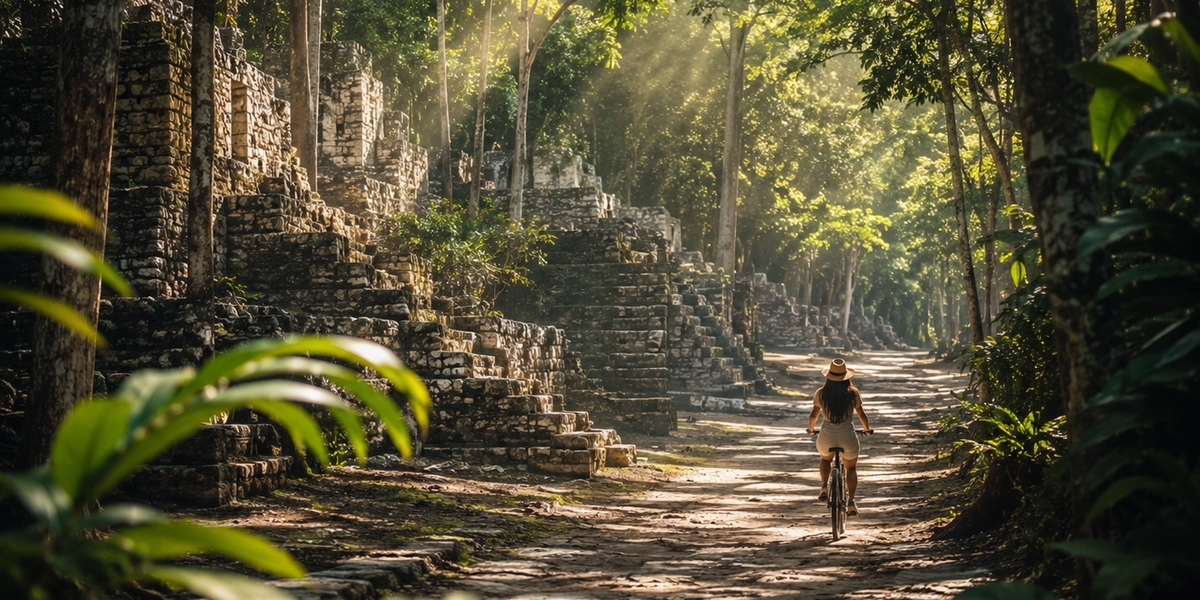
Cobá was once one of the largest cities of the ancient Maya world, and the part that survives is scattered, not stacked. Instead of a single cleared plaza, you get several distinct groups of ruins spread across a few kilometers of forest, connected by sacbeob — the raised white stone roads the Maya built between settlements. Walking from the entrance to the main pyramid and back is most of an afternoon on foot; that's exactly why bikes and pedicabs exist here and almost nowhere else.
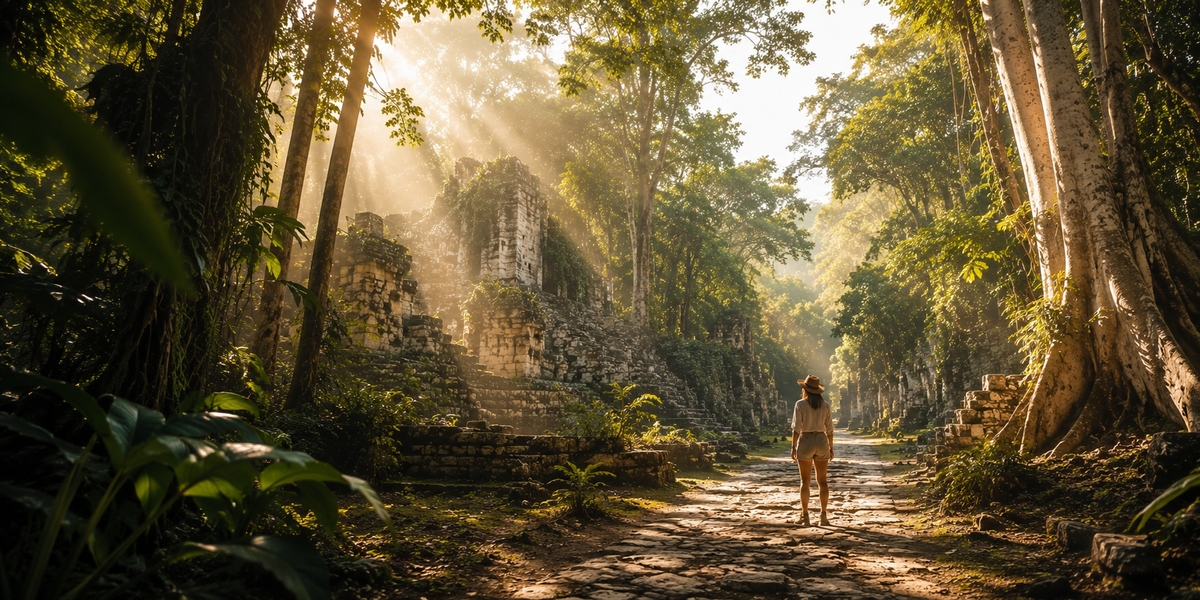
The setting is the whole point. At Chichen Itza you stand in open sun on manicured lawns. At Cobá the jungle is still in charge: trees close over the paths, the temperature drops a few degrees in the shade, and you hear birds and the occasional rustle long before you reach the next cluster of stone. Much of the site remains only partly excavated, with mounds that are clearly buildings still wrapped in roots. It reads less like a museum and more like a place archaeologists are still uncovering, because they are.
That atmosphere comes with a fair trade-off worth saying plainly: Cobá is less visually dramatic in a single frame than its neighbors. There's no one iconic, fully restored backdrop like El Castillo at Chichen Itza or the cliff-edge temple at Tulum. The reward isn't the hero shot — it's the hour you spend moving through a living forest with ruins in it.
Yes, You Can Climb the Pyramid Again (2026 Update)
Here's the fact that trips up returning travelers and outdated blog posts alike. Nohoch Mul — "large hill" in Yucatec Maya, and the tallest pyramid on the Yucatán Peninsula — was closed to climbers for years. Plenty of guides still say flatly that you can't go up. As of late 2025 that's wrong.
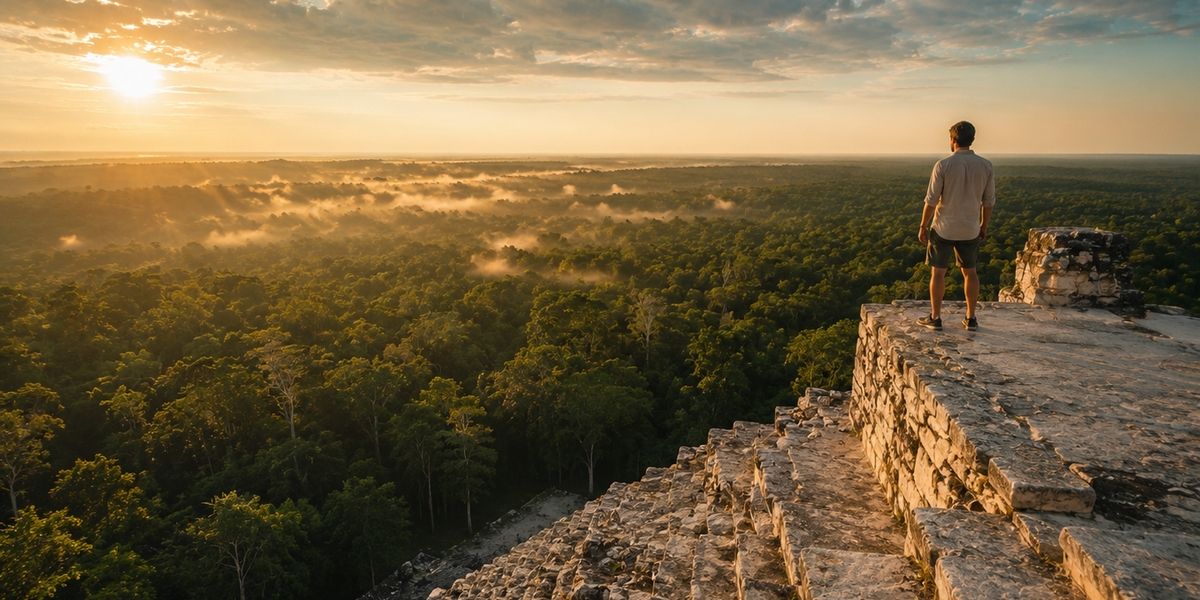
Mexico's INAH (the national institute for anthropology and history, which manages the country's archaeological sites) reopened Nohoch Mul for climbing on December 8, 2025, after about a six-year closure. To protect the original steps, they built a new wooden staircase over the old stone ones, and access now runs in small, timed groups with a few minutes at the top to take in the view over the canopy. The result is the rarest thing in Yucatán ruins: a major pyramid you're actually allowed to climb.
A few honest caveats. The climb is steep and the steps are tall, so it's not for everyone — anyone uneasy with heights or hard on the knees can skip it and lose nothing of the jungle experience. Group sizes and timed access mean you may wait a little at peak hours, which is one more argument for arriving early. And like everything else here, the rules can be tightened again by the site authorities; treat the open staircase as the current reality rather than a permanent guarantee, and check on the day.
How to Get to Cobá
Cobá sits inland, away from the coast road, which is the only reason it isn't overrun. The drive is straightforward from anywhere on the Riviera Maya, but the time it eats varies a lot by where you start.
Those numbers do most of the deciding for you. From Tulum, Cobá is a genuinely short hop and the obvious half-day. From Cancún it's a real commitment — four to five hours of driving round trip — which is why a Cancún-based visit almost always pairs Cobá with something else rather than going just for the ruins. How you cover that distance comes down to three honest options.
Rental car — the most flexible
- Go at dawn, beat the tour buses, and leave when you want;
- Easy to add a cave cenote or lunch in Valladolid on the same loop;
- Best value for two or more people once you split fuel and the modest parking fee.
ADO bus — the budget route
First-class ADO buses connect Cobá with Tulum, Playa del Carmen and Cancún for a fraction of a tour's price. The catch is frequency: departures are limited and the last bus back can be early-afternoon, so this works only if you build the day around the timetable. Check the return before you ride out, not after.
Organized tour — the no-logistics call
Most Cancún and Playa visitors take a guided tour, and for good reason: it folds the long drive, tickets, a guide, and usually a cenote into one booking. You trade flexibility and an early start for zero planning. Worth it if the distance from your base is the main obstacle.
If you're weighing wheels versus a booked seat more broadly, the guide to renting a car in the Riviera Maya covers the real costs and quirks of driving here, and the ADO bus vs transfer vs rental comparison lays out which mode suits which kind of trip. For Cobá specifically, the rule of thumb is simple: based in Tulum, drive or take the bus; based in Cancún, take a tour unless you genuinely want the freedom of a car for the day.
The practical numbers (checked June 2026)
The exact figures move — Mexico raised foreign-visitor fees at several sites on January 1, 2026, so treat these as a current range, not a promise. As of June 2026, foreign visitors pay an INAH ticket of roughly 210 MXN plus a local community (ejido) fee of around 100–120 MXN, so budget about 310–330 MXN (~$17–19) per person to enter. A bike inside runs about 80–100 MXN, or a pedicab with a driver around 150–200 MXN for two. The gate is open 8:00 to 17:00, with the last tickets sold in the early-to-mid afternoon (roughly 3–4 pm) and the pyramid climb running until about 3:30 pm — one more reason to arrive early. There's a paid lot at the main entrance (about 20.494° N, 87.735° W; roughly 60–80 MXN per car).
Cobá vs Chichen Itza vs Tulum: Which Ruin Earns Your Day?
This is the comparison that matters, because few travelers visit all three. Each does one thing better than the others, and the right pick depends on whether you're chasing grandeur, sea views, or atmosphere. Here's how they actually stack up for a day-tripper.
| What matters | Cobá | Chichen Itza | Tulum |
|---|---|---|---|
| Setting & feel | Deep jungle Explore by bike; shaded, wild, spread out. |
Open & grand Restored, monumental, walked on foot in full sun. |
Cliff & sea Small site, dramatic Caribbean backdrop. |
| Climb the main pyramid? | Yes (since Dec 2025) | No (closed 2006) | No, never allowed |
| Price to visit Foreigners, approx. |
Lower ~310–330 MXN (~$17–19), plus bike |
Highest ~600+ MXN (~$32–35) |
Mid–high ~315 MXN, plus park fees |
| Time to visit | 2–3 hr (with biking) | 2–4 hr | 1–2 hr |
| Crowds | Lighter Space absorbs people. |
Heaviest The region's busiest site. |
Busy, tight Crowds feel concentrated. |
| Physical effort | Higher Biking, plus an optional steep climb. |
Moderate A lot of flat walking in open sun. |
Easy Small, flat, quick to cover. |
| Kid-friendly | With a bike Kids love the ride; mind heat and bugs. |
OK Big and hot, with lots of walking. |
Easiest Short visit; watch the cliff edges. |
| Travel time from coast | ~45 min Tulum / 2–2.5 hr Cancún | ~2–2.5 hr from most bases | In Tulum; short from Playa |
| Best for | Atmosphere, movement, climbers | History buffs, first big ruin, scale | Photos, a quick add-on to a beach day |
Read across the rows and the personalities separate cleanly. Chichen Itza is the one to see if you'll only visit a single ruin and want the famous, fully restored scale — it earns its fame, crowds and all. Tulum is less a destination than a 90-minute add-on to a beach day, strong on views and weak on depth. Cobá is the choice when you'd rather feel like you explored something than ticked it off.
So who should genuinely skip it? If your trip allows exactly one ruin and you've never seen a great Maya site, Chichen Itza is the safer first. If long drives wear you down and you're staying in Cancún with no appetite for a tour, the round trip may outweigh the payoff. And if climbing was your whole reason to come, double-check it's open the week you travel before building the day around it.
Make a Day of It: Timing, Combos and What to Bring
Cobá rewards an early start more than almost any site in the area, for two reasons that compound each other: heat and mosquitoes. By late morning the jungle is humid and the bugs are out, and the tour buses from the coast have arrived. Roll in close to opening and you get cooler air, an emptier site, and a shorter wait for the pyramid stairs. This is the single highest-value decision you'll make about the visit.
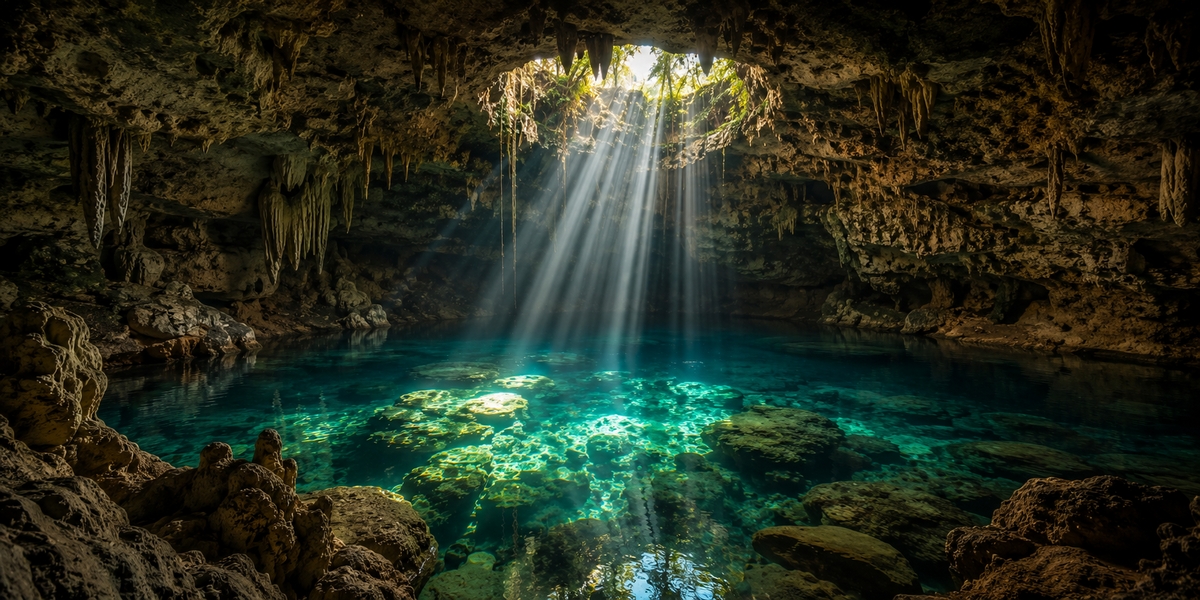
The other smart move is to treat the ruins as half of the day, not all of it. A cluster of cave cenotes — Choo-Ha, Tankach-Ha and Multún-Ha — sits just a few kilometers from the site, and a cool underground swim after a sweaty bike ride is close to perfect. They're a short drive or an ambitious pedicab ride away, cash-only, and far quieter than the famous cenotes nearer the coast. The broader cenotes guide for the Riviera Maya explains how cave, open and semi-open cenotes differ if you want to choose deliberately.
Aim to reach the gate near the 8 a.m. opening. From Tulum that's a relaxed start; from Cancún it means a genuinely early alarm.
Rent a bike at the entrance, ride out to Nohoch Mul, climb it while it's cool, then loop the other groups on the way back.
Choo-Ha, Tankach-Ha or Multún-Ha — pick one for a cold swim. Bring a towel and small peso notes for entry.
Lunch in Tulum town on the way back, or detour to colonial Valladolid if you drove and want more than ruins.
To put the time in perspective with a concrete example: based in Tulum, the whole loop — 45 minutes out, two to three hours at the ruins, an hour at a cenote, and the drive back — is a comfortable half-day that leaves your afternoon open. Run the identical plan from Cancún and the two-plus-hour drive each way turns it into a full nine-to-ten-hour day. Same ruins, very different commitment. That gap, not the entry fee, is the real cost of visiting Cobá from the wrong base. If you're stitching several sites together, the day trips from Cancún overview shows where Cobá fits among the alternatives.
As for what to carry: pesos in cash above all, because nothing on site takes a card. Then serious insect repellent — the jungle earns its mosquitoes, and this is not the place to forget it — along with water, sun protection, and shoes you can grip stone stairs in. A swimsuit and towel if the cenote is in the plan. Skip the drone unless you've checked the current rules; they shift.
Sources Checked
Sources checked on June 19, 2026. Opening hours, entry and bike-rental fees, bus timetables and climbing access all change by season and by decision of the site authorities, so confirm the details that matter to you close to travel — especially that the pyramid is still open to climbers the week you go.
How this guide was checked: We confirmed the December 8, 2025 reopening of the Nohoch Mul pyramid and current visiting rules against INAH and recent, dated travel reporting, and cross-checked travel times, entry fees (including the January 1, 2026 increase for foreign visitors), bike-rental and parking prices, opening hours, on-site logistics (bikes, pedicabs, cash-only entry) and the nearby Cobá cenotes across multiple current sources. Where figures varied between sources, we kept the language to current ranges and flagged what to verify on arrival.
Frequently Asked Questions
Can you still climb the pyramid at Cobá?
Yes. After roughly six years closed, INAH reopened the Nohoch Mul pyramid for climbing on December 8, 2025, using a new wooden staircase built over the original stone steps. That makes Cobá the only major archaeological site in the Yucatán Peninsula where you can still climb the main pyramid — Chichen Itza closed its pyramid to climbers in 2006, and Tulum never allowed it. Climbing runs in small groups during set hours, so go early and expect a short wait at busy times.
How do you get to Cobá from Tulum, Playa del Carmen or Cancún?
Cobá sits inland, about 45 minutes by car from Tulum, roughly 1.5 to 2 hours from Playa del Carmen, and around 2 to 2.5 hours from Cancún. A rental car is the most flexible option and the easiest way to add a cenote afterward. The ADO bus is the cheapest route but runs on a limited schedule, so check return times before you commit. Organized tours cost more but remove all the logistics, which is why most Cancún and Playa visitors use one.
Do you need a bike at Cobá?
It helps a lot. Cobá is spread across several ruin groups linked by old Maya roads through the jungle, and the Nohoch Mul pyramid sits about 2.5 km from the entrance. You can walk it, but in midday heat that turns the visit into a slog. Most people rent a bicycle just past the entrance or hire a pedicab (a driver pedals you between the groups), both paid in cash on site.
Is Cobá worth visiting if you've already seen Chichen Itza or Tulum?
Often yes, because it offers something the other two don't: a real jungle setting, far fewer crowds, the freedom to move around by bike, and a pyramid you can actually climb. Chichen Itza wins on scale and restored grandeur; Tulum wins on its cliff-top sea views. Cobá wins on atmosphere and the sense of exploring rather than filing past barriers. If you found Tulum's ruins small and crowded, Cobá is the better half-day.
How much time do you need at Cobá?
Plan on about 2 to 3 hours for the ruins themselves, including biking between the groups and climbing Nohoch Mul. Add a nearby cave cenote and lunch in Tulum or Valladolid and it becomes a comfortable half to full day. It does not need an overnight — most travelers visit Cobá as a day trip from Tulum, Playa del Carmen or Cancún.
What should you bring to Cobá?
Cash in Mexican pesos first — the ticket booths don't take cards or dollars, and the bike rental and nearby cenotes are cash only too. Then strong insect repellent (the jungle has far more mosquitoes than the coast), plenty of water, sun protection, and comfortable shoes with grip for the pyramid stairs. Arrive close to opening to beat both the heat and the tour-bus crowds.
Cobá in One Minute
The short version, if you don't want to re-read the whole thing.
If you remember one thing: Cobá is the ruin for people who'd rather explore than tour — and, for now, the only major Yucatán pyramid you can climb.
For most travelers, the clean recommendation is to visit Cobá as a half-day from Tulum, early in the morning, paired with a cave cenote. That's where its short drive, jungle atmosphere, and the reopened pyramid all line up in your favor.
If you're Cancún-based with time for only one ruin, lead with Chichen Itza instead and save Cobá for a return trip — it's the kind of place that rewards a slower second visit more than a rushed first one.