
Almost everyone arriving in Cancun makes this decision twice: once on the booking screen, where the cheapest line always looks like the smart one, and again in the arrivals hall at 11 p.m., tired, holding two suitcases, watching a crowd funnel toward a row of transfer desks. The choice that looked obvious online rarely survives contact with the actual airport.
The trap is treating ADO, a private transfer, and a rental car as three prices for the same thing. They are not. They are three completely different trips: a bus that runs city to city on a fixed route, a car that comes to your door and drops you at the hotel, and a vehicle you own for the week and have to drive, park, fuel, and insure. The cheapest one on paper is regularly the worst one for the trip you are actually taking.
This guide compares them the way a second-time visitor would — not "which is cheapest," but "which one matches my route, my luggage, my arrival time, and how much I actually plan to leave the resort." We will start with a fast answer, then put the three side by side, then break it down by where you are heading.
Quick Answer: Which One to Pick
Short version: a private transfer is the low-stress default, the ADO bus is the genuine value pick on the Playa and Tulum corridors in daylight, and a rental car only earns its keep if you will drive most days. Here is the fast read by trip type:
- First trip, Hotel Zone resort — private transfer; start the holiday calm, not negotiating.
- Budget couple heading to Playa del Carmen by day — ADO; this is its sweet spot.
- Family with kids and lots of luggage — private transfer; the bus math stops working with bags and strollers.
- Cenote, ruins and small-town explorer — rental car; nothing else gives that range.
- Late-night arrival anywhere — private transfer; the State Department advises against intercity driving and street taxis after dark.
- Tulum beach base, one or two outings — transfer in, then taxis and tours; skip the car.
A clean, reliable intercity bus from the airport to Playa del Carmen and Tulum. On those routes in daylight it is the best value by a wide margin, if you travel light.
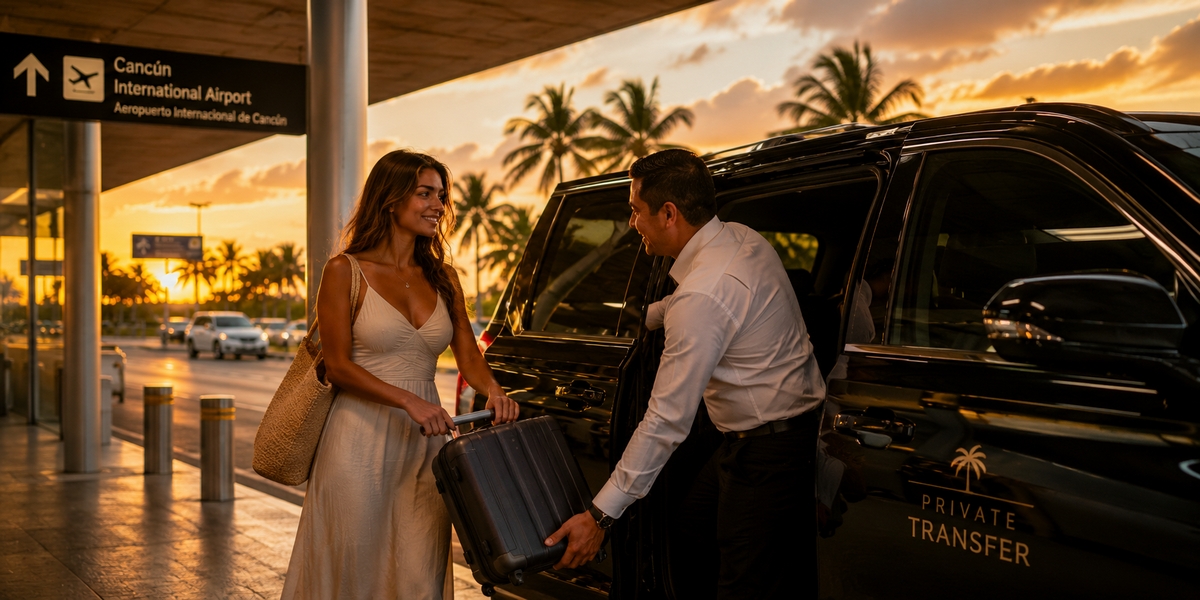
A car meets you and takes you straight to the hotel. You pay for certainty: no waiting, no bus-to-taxi handoff, no driving after a long flight. The default for families and night arrivals.
Total independence for cenotes, ruins, and roadside towns on your own clock. Brilliant for an explorer's week, wasteful for a resort one.
The Three Options at a Glance
Before the detailed comparison, it helps to see what each one actually is, because the differences are structural, not just financial. One is a scheduled bus between city stations, one is a private door-to-door car, and one is a vehicle you operate yourself. The rough numbers below are 2026 ranges for the most common routes; the longer the haul, the wider the gap between them.
Read those pills and the pattern is already visible. ADO is priced per seat, so it stays cheap no matter how far you go. A private transfer is priced per trip and climbs steeply with distance — the ride to Tulum can cost three to four times the ride to the Hotel Zone. A rental is priced per day, which means its value is entirely about how many of those days you actually spend driving. The full airport transfer guide breaks the from-the-airport leg down route by route if that first ride is your main worry.


Side by Side, Honestly Compared
This is the table to screenshot. Each row is a thing travelers actually care about on the ground, scored qualitatively rather than with invented precision. No option wins every row, which is the entire point: you are choosing which compromises you can live with for your specific trip.
| What matters | ADO bus | Private transfer | Rental car |
|---|---|---|---|
| Cost per ride | Lowest Per-seat pricing stays cheap even to Tulum. |
Higher Per-trip; climbs steeply with distance. |
Per day Cheap base, but all-in once insured. |
| Door-to-door | No Station to station; you arrange the last mile. |
Yes Airport straight to your hotel lobby. |
Yes But you are the one driving and parking. |
| Luggage & family | Light only Fine solo; awkward with kids and many bags. |
Easiest Seats, car seats on request, no transfers. |
Depends Space, yes; wrangling it after a flight, less so. |
| Day-trip freedom | Limited Tied to routes and timetables. |
Bookable Great per trip, but you pay each time. |
Total Cenotes and ruins on your own clock. |
| Night arrival | Thinner Fewer late runs; last mile harder after dark. |
Best Calm, pre-arranged, waiting for you. |
Worst Unfamiliar roads at night, advised against. |
| Overall hassle | Some Cheap, but you manage the connections. |
Lowest You buy the absence of logistics. |
Highest Insurance, deposit, fuel, parking, driving. |
One row deserves a flag, because it is the most common 2026 surprise: the ADO bus does not serve the Cancun Hotel Zone. It runs to the downtown Cancun station, so a Hotel Zone traveler still faces a taxi across town — which usually wipes out the saving that made the bus attractive. ADO is excellent for Playa del Carmen and Tulum and a poor fit for a Hotel Zone resort, and that single fact reshuffles the whole table depending on where you are sleeping.
When Each One Actually Wins
Strip away the marketing and each option has a clear home turf. The skill is recognizing which trip you are on before you book, not after.
When the ADO bus is the smart call
- you are going to Playa del Carmen or downtown Tulum, not the Hotel Zone;
- you land in daylight and can handle a short taxi at the other end;
- you travel light, without strollers or a stack of suitcases;
- you want real savings, not just the cheapest line in a table.
When a private transfer earns its price
If it is your first trip, you land at night, you are traveling with kids, or you simply want the holiday to start the moment you clear customs, a private transfer is worth the premium. It removes every decision between the plane and the hotel bed, which after an international flight is exactly the thing most people undervalue until they are standing in the arrivals hall negotiating. It is also the steadiest choice for the long, fiddly run down to Tulum's beach zone.
When a rental car pays off
A car wins when driving is the trip, not a chore attached to it: cenotes off Highway 307, Valladolid, Akumal, ruins, and roadside towns that no single tour strings together. If you will genuinely use it most days, it is the cheapest real freedom in the region. If it will mostly sit in a paid lot, it is the most expensive way to do nothing — the full math is in the rental car cost breakdown.
What Each Destination Actually Asks For
Geography decides this more than budget does. The same three options rank completely differently depending on whether you are sleeping in the Hotel Zone, in Playa, in Tulum, or at a resort somewhere off the highway. Walk the coast south and the smart pick changes at every stop.
Where every version of this decision is made — usually while tired and holding luggage. Pre-booking anything beats deciding here.
Private transfer or shuttle territory. ADO does not come here, and a rental just collects resort parking fees if you are staying put.
The one route where ADO genuinely shines: direct to a central station, cheap, walkable on arrival. Private transfer only if bags or a night landing tip the scale.
The route that punishes the wrong call. Private transfer for the smooth version; ADO plus a final taxi for the budget version; a rental only if cenotes are the plan.
A worked example makes the trade-off concrete. Picture a couple, five nights in Playa del Carmen, arriving by day, planning two outings. Round-trip ADO to the airport runs roughly $30 total for both of you, with a short taxi each end. A round-trip private transfer is closer to $140–200. A rental car for five days lands near $300+ all-in once mandatory insurance, fuel, and parking are counted — and it would sit unused for three of those days. For this trip the bus is not the desperate choice; it is the rational one, and the tours cover the outings. Flip the couple to a cenote-hopping explorer's week and the rental quietly becomes the best value of the three. Same coast, opposite answer.
Mistakes That Quietly Cost Money or Time
Most transport regret here is not bad luck. It is a small assumption that one extra check would have corrected.
Booking ADO to a Hotel Zone resort. The bus stops downtown, not at the strip. The taxi to finish the trip often costs more than the fare you saved, and you do it tired with bags.
Renting a car for a resort week. If you leave the property twice, the deposit hold, insurance, and parking make it the most expensive option by far — for a car that mostly waits in a lot.
Taking the bus at night with luggage. Late runs are thinner and the last-mile taxi is harder to arrange after dark. This is exactly when the State Department's daylight-and-pre-booked advice matters most.
Comparing only the headline numbers. A $15 bus fare and a $22/day car both hide their real totals. Compare door-to-door cost and time, including the last mile and mandatory insurance, not the advertised line.
If your plan leans toward day trips rather than a single base, that changes the calculus too — the day trips guide shows which outings are easy by tour or bus and which genuinely reward a car, and the Cancun budget guide folds transport into the bigger spend so the cheap-looking line does not quietly blow the week.
Sources Checked
Sources checked on June 11, 2026. Fares, schedules, and rental pricing shift by season, operator, and demand, so confirm current numbers close to travel, especially for night arrivals and holiday weeks.
How this guide was checked: We cross-referenced published ADO intercity routes and typical fare ranges, common private-transfer and rental pricing for the Cancun and Riviera Maya corridors, and the U.S. State Department's Mexico travel advisory and driving guidance for Quintana Roo. The aim is not to quote one exact fare, but to help you match the right option to your route, your luggage, and your arrival time.
Frequently Asked Questions
Should I take the ADO bus, a private transfer, or rent a car in Cancun?
Match the tool to the trip. Take a private transfer if you want a calm, door-to-door start after a long flight, you are traveling with kids or heavy bags, or you land at night. Take the ADO bus if you are budget-focused, traveling light, and heading to Playa del Carmen or downtown Tulum in daylight, where it is genuinely good value. Rent a car only if you will actually drive most days, chasing cenotes, ruins, and small towns on your own schedule. Most resort-based travelers do best with a transfer and the occasional taxi or tour, not a rental that sits in a parking lot.
Does the ADO bus go to the Cancun Hotel Zone?
No, and this is the detail that catches people. ADO runs from Cancun Airport to the downtown Cancun bus station, not to the Hotel Zone resort strip. To reach your Hotel Zone hotel you would still need a taxi or local bus from downtown, which adds time and cost and usually erases the savings. For the Hotel Zone, a pre-booked private transfer or a shared shuttle is the simpler call; the ADO bus only makes real sense for Playa del Carmen and Tulum.
Is the ADO bus a good way to get from Cancun Airport to Playa del Carmen?
Yes, Playa del Carmen is where the ADO bus is at its best. It runs directly from the airport to Playa's central station in roughly 50 to 70 minutes, often for around $12 to $18, and the station sits within walking or short-taxi distance of much of the town. For a daytime arrival without small kids or a mountain of luggage, ADO can beat both a rental car and a private transfer on total cost with very little added hassle. If you land late at night or have a lot of bags, a private transfer is worth the difference.
Is a rental car cheaper than private transfers in the Riviera Maya?
Only if you drive enough to justify it. The headline rental rate looks cheap, but Mexican law requires third-party liability insurance that is rarely in the online price, so the all-in daily cost is often $55 to $80 once mandatory cover, fuel, and parking are added, plus a deposit hold of $1,000 to $2,500. For a resort week with one or two outings, a couple of transfers and a tour cost less and stress you less. A rental wins on cost only when independent driving is the core of the trip, not an afterthought.
What is the best way to get from Cancun to Tulum?
For most travelers, a private transfer is the smoothest way to Tulum, because the drive is long at roughly one hour 45 minutes to two hours 20 minutes and the last mile to a beach-zone hotel is often the fiddly part. The ADO bus is a solid budget choice to downtown Tulum, usually around $18 to $28, but you will likely need a taxi for the final leg to the beach zone. A rental car only makes sense for Tulum if you plan to use it for cenotes and day trips, since beach-zone parking is scarce and pricey.
Is it safe to take the ADO bus or drive in the Riviera Maya?
Both are reasonable with normal caution. ADO is a well-established intercity bus line and one of the lower-stress ways to move around the region. For driving, Quintana Roo sits at Level 2 on the U.S. State Department advisory, and the main Highway 307 corridor is a well-maintained, well-lit divided road. The State Department advice is to drive between towns in daylight, use toll roads where possible, and stay calm at any checkpoint. It also recommends not hailing taxis off the street, so pre-book or use an app for taxis rather than flagging one down.
If you remember one line: book the transfer for peace of mind, take ADO when the route and the daylight line up, and rent a car only when driving is the holiday.
For most first-time and resort-based travelers, a private transfer in and out, with taxis or tours for the occasional outing, is the right default — it costs more than the bus but removes the friction where it hurts most. If you are budget-minded and headed to Playa del Carmen or Tulum by day, the ADO bus is not a downgrade; it is the sharp choice.
And if your week is built around cenotes, ruins, and the open road rather than a single beach, stop comparing it to a transfer at all — that is the one trip where a rental car is worth every peso of the hassle.