
Every winter, a few million Americans and Canadians board a three-to-four-hour flight to a place most of them could not point to on a map a month earlier. Punta Cana has become the default Caribbean answer: the flights are cheap, the all-inclusive math is friendly, and the photos all show the same impossibly wide white beach. Most of those travelers have a great week.
The ones who don't usually made the same mistake: they booked Punta Cana expecting a destination, and it is not one — not in the way Cancun, Jamaica, or even Aruba is. Punta Cana is a purpose-built resort region where the property you choose is the trip. There is no town square to wander into, no strip of local restaurants a short walk from your room, and taxis cost enough that "we'll just explore" quietly becomes "we'll just stay in."
None of that is a flaw once you know it going in. This guide covers what the region actually is, the free entry form that scam sites charge $30 for, when to go, how money works, and what happens in your first thirty minutes at the airport — so your expectations land before you do.
Quick Answer: What First-Timers Need to Know
If you only read one section, make it this one:
- Punta Cana is a resort strip, not a city — your resort choice is 90% of the vacation.
- The eTicket entry form is mandatory and free at the official site; anyone charging you for it is a middleman or a scam.
- Everyone needs a passport, including US citizens; no visa for stays up to 30 days.
- December–April is the dry season; August–October is the hurricane window.
- US dollars work everywhere in the tourist zones — you can skip pesos entirely.
- Verdict: best-in-class for an all-inclusive relax; wrong choice if you want to explore.
Beach, pools, swim-up bar, buffet, repeat. Punta Cana executes this formula at a better price than almost anywhere in the Caribbean, with nonstop flights from most of the US and Canada.
Travelers who measure a trip in towns walked, ruins climbed, and local meals found tend to come home from Punta Cana underwhelmed — not because it failed, but because it was never built for that.
Punta Cana Quick Facts
| Fact | What to know |
|---|---|
| Currency | Dominican peso (DOP) — but a resort week rarely needs it |
| Paying in US dollars | Accepted everywhere tourists go: taxis, excursions, tips, resort extras |
| Language | Spanish; English is standard in resorts and tourist services |
| Flight time | ≈2 h from Miami • ≈4 h from New York or Toronto, nonstop |
| Visa | None for US/Canadian tourists up to 30 days — passport required for everyone |
| eTicket | Mandatory entry form, free at eticket.migracion.gob.do |
| Airport | Punta Cana International (PUJ), 20–50 min from most resorts |
| Best months | December–April dry season; August–October is the storm window |
What Punta Cana Actually Is
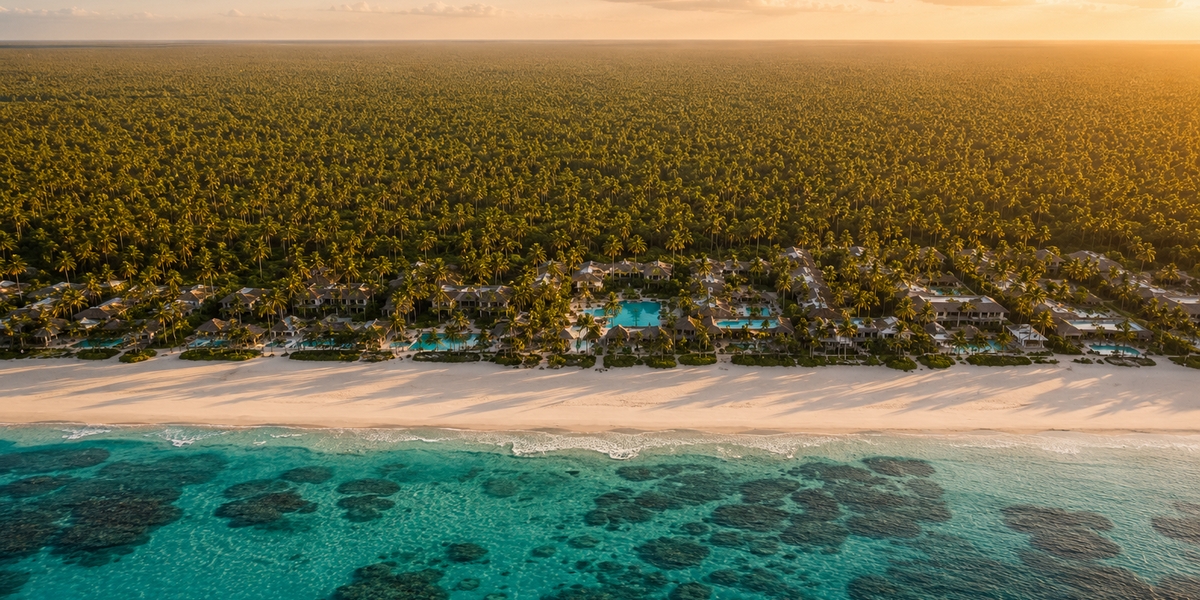
On paper, Punta Cana is the eastern tip of the Dominican Republic, the second-largest country in the Caribbean. In practice, the name covers a roughly 30-mile coastal corridor of gated resort districts strung along a highway — Uvero Alto in the north, then Macao, then the huge Bavaro cluster, then Cap Cana below the airport. Each district is a world of walled resorts facing its own stretch of beach, connected to the others by taxi rides that cost real money.
What surprises most first-timers is what's between the resorts: not much. Service towns like Veron and Friusa exist for the people who work in the hotels, not for tourists. The closest thing to a walkable tourist zone is the small Los Corales / El Cortecito pocket in Bavaro — a few streets of restaurants and souvenir shops — and even that is a taxi ride from most properties. After dinner, the region goes quiet in a way that shocks people who imagined a Caribbean Cancun.
The beaches themselves are the real thing. Bavaro's sand is as wide and white as the marketing says, the water inside the reef stays calm most of the year, and big resorts groom their beachfront with tractors every morning during seaweed season. The postcard is honest. It just doesn't come with a city attached.
Punta Cana Is Not Cancun — and That's the Point
Because both destinations sell the same turquoise postcard, US and Canadian travelers treat them as interchangeable. They are not, and the difference decides who comes home happy. Cancun sits next to a real city, a party strip, and a peninsula full of Mayan ruins, cenotes, and towns like Valladolid — a rental car or a bus turns a resort week into a road trip. We broke that choice down fully in our Punta Cana vs Cancun comparison, but the short version matters here.
Punta Cana made the opposite bet. It concentrated everything inside the resorts and let the surrounding region stay rural. The result is a purer, often cheaper all-inclusive product — Dominican resorts compete ferociously on value, and a 5-star week here frequently prices like a 4-star week on the Mexican coast, something we dig into in the three-way all-inclusive comparison.
What you give up:
- No historic sites within easy reach — the colonial capital, Santo Domingo, is 3+ hours each way.
- No walkable town life — dinner "out" means another resort or a taxi to a tourist pocket.
- No cheap transport — no Uber pickup in the resort zone, no tourist bus network, taxis at fixed premium rates.
Read that list again before booking. If it sounds like a relief — nothing to plan, nowhere to be — Punta Cana is your place. If it sounds like a cage, it will feel like one by day four.
The Resort Districts, Compared
Choosing the district is the one genuine geography decision you make in Punta Cana, because it sets your beach, your noise level, and your price bracket all at once.
Bavaro
The widest, most famous beach and the largest concentration of resorts, restaurants, and excursion pickups. Shallow, calm water that families love. The trade: the most neighbors on the sand, and the district most affected when seaweed season peaks.
Cap Cana
A gated master-planned zone south of the airport with a marina, golf, and Juanillo Beach — shallow, glassy water in a protected bay that shrugs off seaweed better than Bavaro. Noticeably quieter, noticeably pricier.
Uvero Alto
Newer resorts spaced far apart on a wilder, golden-sand coast. Real waves — dramatic to look at, not ideal for toddlers. The pick for couples who want modern rooms and no crowds, accepting a 40–50 minute airport transfer.
La Romana & Juan Dolio
Separate coastal zones an hour-plus southwest, built around Casa de Campo and quieter beaches. Only worth considering if you have been to Punta Cana before or specifically want distance from the main corridor.
Here is the same decision as a table — the closest thing this region has to a map that matters:
| District | Beach & water | Atmosphere | Price level | Best for |
|---|---|---|---|---|
| Bavaro | Wide, calm, shallow | Busy, social, most services | $ – $$$ | Families, first-timers, groups |
| Cap Cana | Protected bay, clearest water | Quiet, polished, gated | $$$ – $$$$ | Couples, luxury, honeymoons |
| Uvero Alto | Golden sand, real waves | Secluded, modern, spread out | $$ – $$$ | Couples, adults-only seekers |
| La Romana / Juan Dolio | Calmer, smaller coves | Removed from the main strip | $$ – $$$$ | Repeat visitors, golfers |

Before You Fly: eTicket, Passport, Entry
Dominican entry is genuinely simple — which is exactly why an industry of lookalike websites exists to complicate it for a fee. Three things cover almost every US and Canadian tourist:
The eTicket — mandatory, free, and worth doing early
The Dominican Republic requires one online form per trip that combines migration, customs, and health declarations. The only official site is eticket.migracion.gob.do — it is free, takes about ten minutes, and issues a QR code you show at passport control. Fill it out at home before departure, not on airport Wi-Fi with a line behind you, and screenshot the QR code in case your signal drops.
Passport — yes, even for US citizens
- Everyone arriving by air needs a valid passport — no exceptions for US or Canadian citizens;
- validity must cover at least your whole stay; six months' buffer is the safer habit;
- no visa needed for tourist stays up to 30 days — longer stays pay an extension fee at departure.
The tourist card — already paid
The old $10 tourist card that travelers once bought on arrival has been folded into airfare on virtually all flights from the US and Canada. If someone at the airport or a website offers to sell you one, you are being asked to pay twice for something you already own.
For current entry details and advisories, the U.S. State Department's Dominican Republic page and the Government of Canada travel advice are the two sources worth checking the week before you fly.
Weather and Seasons: When the Postcard Is Real
Punta Cana runs on the standard Caribbean calendar, with a couple of local quirks worth knowing. December through April delivers the brochure: sun, manageable humidity, water like a pool inside the reef. This is also when a January week can cost double a September one, and when charter flights from every cold city in North America land wingtip to wingtip.
The rainy season is gentler than the name suggests. Most rain arrives as short, hard afternoon downpours that end as abruptly as they start — all-day washouts are rare outside actual storm systems. The heavier trade-offs are humidity, mosquitoes at dusk, and seaweed: sargassum tends to peak on Bavaro's open coast roughly July through September, while Cap Cana's protected bay and Uvero Alto's wave-swept shore usually fare better — the same geography-beats-luck logic we mapped for sargassum and hotel geography in Mexico. Big resorts fight it with dawn tractor crews and offshore barriers, and a well-staffed property makes a visible difference.
Hurricane season officially spans June 1 to November 30, peaking August through October. Direct hits on Punta Cana are statistically uncommon — the island's east coast has been brushed far more often than struck — but "uncommon" is not "never." NOAA publishes its Atlantic outlook each spring; if you book the peak-risk window, flexible rates and travel insurance are the rational price of the discount, the same logic we apply to hurricane season on the Mexican coast.

Money: Dollars, Tips and Taxi Math
Here is the part that makes Punta Cana unusually easy: for a resort week, you can treat it as a US-dollar destination. Excursions, taxis, spa menus, and tips are all quoted in dollars, and Dominican pesos only matter if you head to local supermarkets or towns outside the corridor. Bring a stack of small bills — $1s and $5s — because tipping is where cash actually leaves your wallet.
What usually surprises tourists is the bill structure when they do eat off-resort: Dominican law adds a 10% service charge plus 18% tax to restaurant bills, so the menu price understates dinner by more than a quarter. The 10% is a legal service charge, not a voluntary tip — an extra 5–10% for good service is customary on top, but nobody should guilt you into tipping twice. And the card-terminal rule that saves money in every dollar-friendly destination applies here too: if a terminal offers to charge you in USD instead of pesos, decline — that "convenience" conversion is the same trap we explain in our travel-cards guide.
The real hidden cost of Punta Cana is movement. There is no Uber pickup in the resort zone and no meaningful public transit for tourists, so every trip beyond your gate is a fixed-rate taxi. Run one honest example before you book a cheaper resort "just a short ride" from the action: a couple taking a taxi from a Bavaro resort to the El Cortecito restaurant pocket pays roughly $20–30 each way. Do that four evenings and you have spent $160–240 on rides alone — most of the price gap to the better-located resort you passed on. In Punta Cana, location is not about sightseeing; it is about how much your resort's isolation taxes every impulse to leave it.
Landing at PUJ: Your First Thirty Minutes
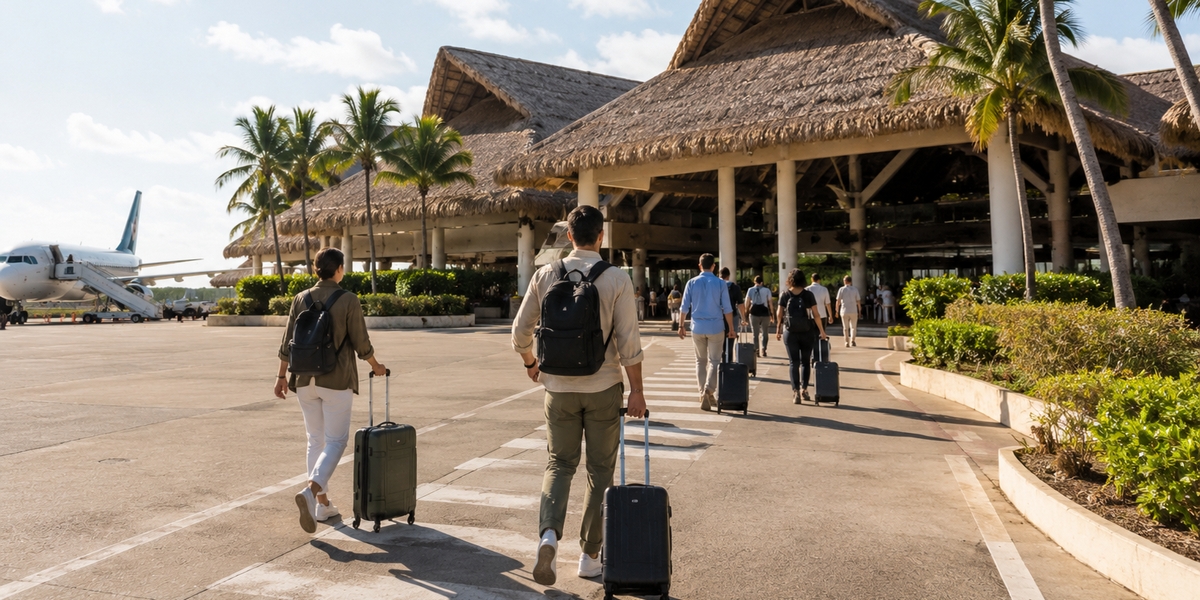
Punta Cana International (PUJ) is unlike any airport most North Americans have used: open-sided terminals under palm-thatch roofs, no jet bridges at many gates, and a wall of tropical heat the moment the aircraft door opens. It is charming and disorienting in equal measure. Here is the whole arrival, in order:
Passport control
Walk the tarmac, join the line — 30–60 minutes at peak charter hours is normal. Have your passport out.
Show your eTicket QR code
The screenshot you saved at home. No printout needed; airport Wi-Fi is not something to depend on.
Collect luggage
Keep your bags in your own hands — "helpers" who grab a suitcase expect payment for the favor.
Ignore the timeshare gauntlet
Friendly greeters offering rides, "welcome breakfasts," or free excursions at the exit. Keep walking; no is a complete sentence.
Find your pre-booked transfer
Look for the sign with your name, or head to the official taxi stand and agree the fixed zone fare before doors close.
The arrivals curb deserves the extra warning. The moment you exit, friendly people will offer to help with bags, find your ride, or — the local specialty — invite you to a "welcome breakfast" that is a timeshare presentation. None of it is dangerous; all of it costs you either money or a morning of your vacation. The move is simple: know your transfer plan before you land, walk past everyone holding anything except a sign with your name, and let go of the reflex to be polite to every greeting.
On transport itself, the options rank cleanly. A pre-booked private transfer is the calmest first-timer choice: fixed price, a name sign, no negotiation with a bag in each hand. Official airport taxis work fine at fixed zone rates ($35–60 to most Bavaro resorts) — agree on the fare before the doors close, since meters do not exist here. Resort shuttles are cheaper but can loop through several properties. What you should not count on is ride-hailing: Uber does not reliably operate for pickups at PUJ or in the resort zone. However you arrive, the same care applies to the trip home — and to vetting the property itself, which is exactly what our pre-booking hotel checklist is for.

First-Timer Mistakes That Actually Cost Money
People worry about the wrong things here. The fears that dominate forums — crime, sharks, "is the water safe" — almost never touch a resort guest. The mistakes below are the ones that actually show up in ruined weeks and surprise charges:
Paying a third-party site for the eTicket. The official form is free. Lookalike sites charge $30–50, and their versions sometimes arrive with errors that mean redoing the form at the airport anyway.
Booking Punta Cana for an exploring vacation. No ruins, no walkable towns, expensive taxis. If your ideal trip is 30% resort and 70% adventures, you have booked the wrong country — that ratio belongs in Mexico.
Choosing the resort on price alone. In a destination where the property is the whole trip, a $40-a-night saving that buys worse food, a groomed-less beach, or an isolated location is the most expensive discount in the Caribbean.
Ignoring seasons because "it's the Caribbean." An August week in Bavaro can mean seaweed lines on the sand and afternoon storms. The same money in late November buys dramatically better odds. Match the month to what you are paying for.
Before You Book
Five checks that cover most of what goes wrong:
Your Next Step
This guide is the orientation layer. Where you go from here depends on which question is actually open:
Read the honest Punta Cana vs Cancun breakdown — trip shape, not marketing photos, decides this one.
The Cancun vs Riviera Maya vs Punta Cana comparison shows where each destination's resort dollar goes furthest.
Run any shortlist through the pre-booking hotel checklist — in a resort-is-everything destination, this is the highest-value 20 minutes of planning.
Big Punta Cana resorts live and die by ratings. The 9.0 rating trap explains when a great score hides the wrong hotel for you.
Sources Checked
Sources checked on July 27, 2026. Entry rules, fees, and seasonal conditions change; verify the official pages close to travel, especially the eTicket portal and any storm outlooks if you fly August through October.
How this guide was checked: We compared official Dominican migration resources, US and Canadian government travel pages, and traveler-facing reporting on arrival logistics, taxi rates, and seasonal beach conditions, prioritizing what first-time visitors most often get wrong before booking.
Frequently Asked Questions
Do US citizens need a passport for Punta Cana?
Yes. Everyone flying into the Dominican Republic needs a valid passport, including US citizens — a driver's license or birth certificate does not work the way it can on some closed-loop cruises. The passport should be valid for at least the length of your stay, though keeping six months of validity is the safer habit for any international trip. US and Canadian tourists do not need a visa for stays up to 30 days.
What is the Dominican Republic eTicket and is it really free?
The eTicket is a mandatory online entry-and-exit form that combines migration, customs, and public-health declarations in one place. It is completely free on the official government portal, eticket.migracion.gob.do. Third-party sites charge $30 or more for the same form, sometimes with errors — fill it out yourself before your flight and screenshot the QR code.
Is Punta Cana an actual city or town?
No, and this is the single most useful thing to understand before booking. Punta Cana is a resort region on the eastern tip of the Dominican Republic — a long coastal strip of gated resort districts (Bavaro, Cap Cana, Uvero Alto) connected by highway. There is no walkable historic center, no malecon, no old town. The resort you choose effectively becomes your destination.
When is the best time to visit Punta Cana?
December through April is the dry season: reliable sun, lower humidity, and historically the cleanest beaches — also the highest prices. May through November brings short tropical downpours, more humidity, and softer rates. The Atlantic hurricane season runs June 1 to November 30 with peak risk August through October; direct hits are statistically rare, but if you book those months, choose flexible rates.
Do I need Dominican pesos in Punta Cana?
For a typical all-inclusive week, no. US dollars are accepted essentially everywhere in the resort zones — excursions, taxis, tips, resort extras are all quoted in dollars. Pesos only become useful if you leave the tourist corridor for local towns, supermarkets, or Santo Domingo. Small US bills for tipping are far more useful than a stack of pesos.
Is Punta Cana or Cancun better for a first trip?
It depends on what you want after breakfast. Punta Cana is the easier, often cheaper all-inclusive vacation — but the resort is essentially the whole trip. Cancun and the Riviera Maya cost more for the same resort tier but surround you with ruins, cenotes, real towns, and day trips. If you plan to leave the property most days, Mexico fits better; if the resort itself is the vacation, Punta Cana usually wins on value.
Punta Cana is the Caribbean's best pure all-inclusive machine: book it when the resort itself is the vacation you want, and it delivers more comfort per dollar than almost anywhere with a nonstop flight from North America.
For most first-timers that means: pick your district before your resort — Bavaro for families and first trips, Cap Cana for quiet luxury, Uvero Alto for couples avoiding crowds — fill out the free eTicket at home, land with a transfer already booked, and let the week be exactly the unambitious, sun-soaked thing it was designed to be.
And if reading this you kept thinking "but what will we do there" — trust that instinct. That trip exists, it is wonderful, and it is in Mexico.