
Most travelers spend weeks choosing a hotel and about thirty seconds choosing which card goes in the wallet. That second decision is the one that follows you through the whole trip. It rides along on every dinner, every tour, every ATM stop, taking a small cut you never see itemized and rarely think to question.
The numbers are not dramatic on any single purchase, which is exactly why they slip past. A 3% foreign transaction fee on a $2,000 trip is $60 gone for nothing. Add a couple of badly handled ATM withdrawals and a "helpful" currency-conversion prompt you accepted at a restaurant, and the wrong card setup can cost more than your airport transfer. None of it buys you anything.
This guide is not a ranking of specific products, and it deliberately names none. Card offers change every quarter, and the right card for you depends on your bank, your country, and how you travel. What does not change is the short list of features that make a card good for Mexico, and the handful of habits that stop the fees before they start. Get those right and the card stops being a line item you lose to.
Quick Answer: What to Bring
If you want the whole strategy in one breath: carry two cards on different networks, make sure at least one charges no foreign transaction fee, use the credit card for spending and a debit card for ATM cash, and always choose to be billed in pesos. Everything below is the detail behind those five lines.
- One no-foreign-fee credit card for hotels, restaurants, tours — anything you tap or insert.
- One debit card for cash, ideally with ATM fees waived or reimbursed, used only at bank ATMs.
- Two networks: Visa or Mastercard as your base; treat American Express as a backup, not your only card.
- Always pay in pesos — never accept the offer to be charged in dollars.
- Tell your bank you're traveling and keep a backup card somewhere separate from your wallet.
And the four numbers worth keeping in your head before you fly:
What a Good Mexico Card Actually Needs
Forget rewards rates for a moment. For a one- or two-week trip, the points you earn are rounding error next to the fees you avoid. Four features do the real work, and a card that nails the first one already puts you ahead of most travelers. The U.S. Consumer Financial Protection Bureau spells out plainly that these surcharges are optional features of a card, not a tax you have to pay — the right card simply doesn't charge them.
No foreign transaction fee
This is the whole game. A card that waives the ~3% surcharge saves you on every single purchase. Most travel cards and most annual-fee cards already do; check the fine print, not the marketing.
ATM fees waived or reimbursed
The feature that separates a good debit card from a costly one. Some checking accounts refund ATM operator fees worldwide, which turns getting pesos from a $5–$10 event into a free one.
Chip, PIN and contactless
Mexican terminals are chip-and-contactless first. Make sure your card taps and that you know your PIN — some ATMs and a few merchants still ask for it, and a forgotten PIN strands your cash plan.
Fraud and travel protections
Credit cards add a buffer between a skimmed number and your bank balance, plus dispute rights. Many also bundle rental-car or trip coverage that quietly duplicates insurance you were about to buy.
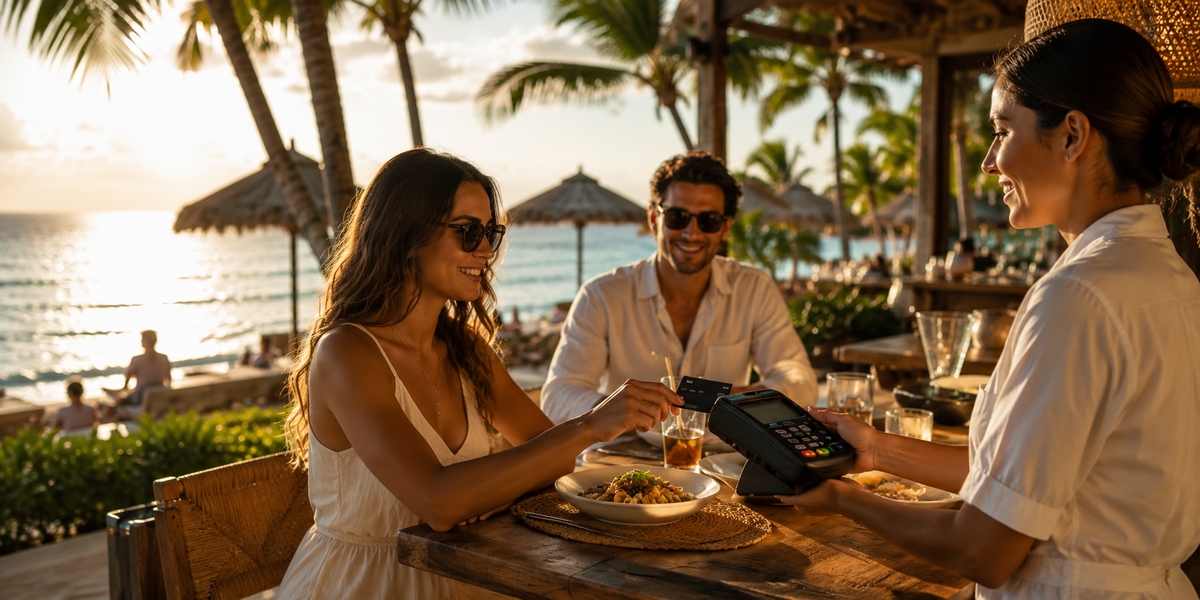
One feature people obsess over deserves less worry than it gets: acceptance. Travelers picture themselves stranded with a card no one will take. In practice, Visa and Mastercard work nearly everywhere a tourist goes on this coast. The real exposure is narrower — American Express, which large resorts and chains accept but smaller restaurants, local tour operators, and family-run shops often do not. If Amex is your only card, that is the gap to close, not card acceptance in general.
Card Network Acceptance in Mexico
It comes down to the logo on the card, not the bank that issued it. Here is roughly how each network fares across the places a traveler actually pays in Cancun and the Riviera Maya.
| Network | Acceptance | Where it shows up |
|---|---|---|
| Visa | Very high | Taken nearly everywhere a card is taken — the safest default for your main card. |
| Mastercard | Very high | Effectively interchangeable with Visa for acceptance; ideal as your second network. |
| American Express | Moderate | Fine at large resorts, hotels, and chains; often refused at small restaurants, local tours, and family shops. |
| Discover / Diners Club | Limited | Spotty even in tourist zones — useful only as a backup, never as your only card. |
Can You Use Cards Everywhere in Mexico?
Mostly yes in the tourist corridor — but not quite everywhere, and the gap is exactly where you'll want pesos. As a rough map of where a card works and where cash still rules:
| Where you're paying | Cards? |
|---|---|
| Hotels and resorts | Cards fine |
| Sit-down restaurants and bars | Cards fine |
| Supermarkets, chains, big tour operators | Cards fine |
| Small vendors, taco stands, family shops | Cash preferred |
| Markets, beach vendors, tips | Cash preferred |
| Taxis and colectivos | Cash only |
So no, you can't go fully cashless — but you can run nearly all of the big spending on a card and keep a modest stack of pesos for the cash-only corners. That split is the whole reason this guide pairs a card with an ATM plan rather than treating them as either-or.
Card Types for Mexico, Compared
There are really four kinds of card you might reach for, and they are not interchangeable. You're not picking a winner here — you're working out which job each one does, because the strongest setup pairs two of them. Here is how they stack up on the things that matter in Mexico.
| Card type | Foreign fee | Best job in Mexico | Watch out for |
|---|---|---|---|
| No-FX travel credit card | Usually none | Hotels, restaurants, tours, car rental — your main spending card, with fraud and dispute protection. | Annual fee on some; never use it at an ATM (cash advance). |
| No-FX debit + ATM rebate | Often none | Pulling pesos at bank ATMs cheaply — the cash side of the trip. | Weaker fraud protection; pulls straight from your balance, so guard the PIN. |
| Prepaid / multicurrency card | Varies | Budget control and a firewall account; useful as a load-and-go backup. | Reload and ATM fees vary widely; weaker dispute rights than credit. |
| Regular home-bank card | Usually ~3% | Fine as an emergency backup; poor as a primary card abroad. | The default everyone packs and the one that quietly costs the most. |
US vs Canadian Travelers: The Difference Is Real
The advice splits along the border more than people expect. The principle is identical — avoid the foreign fee, get cheap cash — but the market each traveler is shopping in is not the same, and Canadians have to look a little harder.
No-foreign-fee is now a baseline feature on most travel and annual-fee cards. On the cash side, a few checking accounts reimburse ATM fees worldwide, which is close to a free-pesos setup if you bank with one.
Most Canadian cards still tack on a foreign-currency conversion charge of around 2.5%. A small set of cards waive it, and US-dollar or multicurrency accounts and fintech cards help close the gap for cash and spending alike.
Whichever passport you carry, it comes down to one step: confirm the foreign-fee line on the card you already own before you assume it's fine. A surprising number of people discover the 3% only when the statement lands. If you're still mapping out the wider money picture — cash, tipping, and how dollars are treated on the ground — the money in Mexico guide is the companion piece to this one, and the cash-declaration rule at the border is covered in the Mexico entry requirements.
Best Card for Each Job
Still naming no products — that ranking would be stale by next quarter. What lasts is the profile of the right card for each role. Match these criteria to what you already own, or to what you're about to apply for, and you've covered every job a Mexico trip throws at a wallet.
Best everyday card
A no-foreign-fee travel or annual-fee credit card on Visa or Mastercard — now a baseline feature, not a premium one. Pair it with a checking account that reimburses ATM fees worldwide and your cash costs drop to near zero.
Best everyday card
One of the short list of Canadian cards that genuinely waive the ~2.5% conversion charge, on Visa or Mastercard. A multicurrency or fintech account closes the gap on both spending and cash. Apply well before you fly.
Best backup card
Any second card on a different network from your primary — ideally also no-foreign-fee, but even a plain one earns its place. Its whole job is to survive a fraud hold or dead terminal, so keep it physically separate.
Best ATM card
A debit card on Visa or Mastercard that waives or refunds operator fees, used only at bank-branch ATMs. Know the PIN, decline the dollar conversion, and pulling pesos becomes a free, routine stop.
The Fees That Quietly Cost You
Card fees abroad rarely arrive as one obvious charge. They stack — a little here at the terminal, a little there at the ATM — and the total only shows up when you add the statement line by line after you're home. These are the six that do the damage, in rough order of how often travelers walk into them.
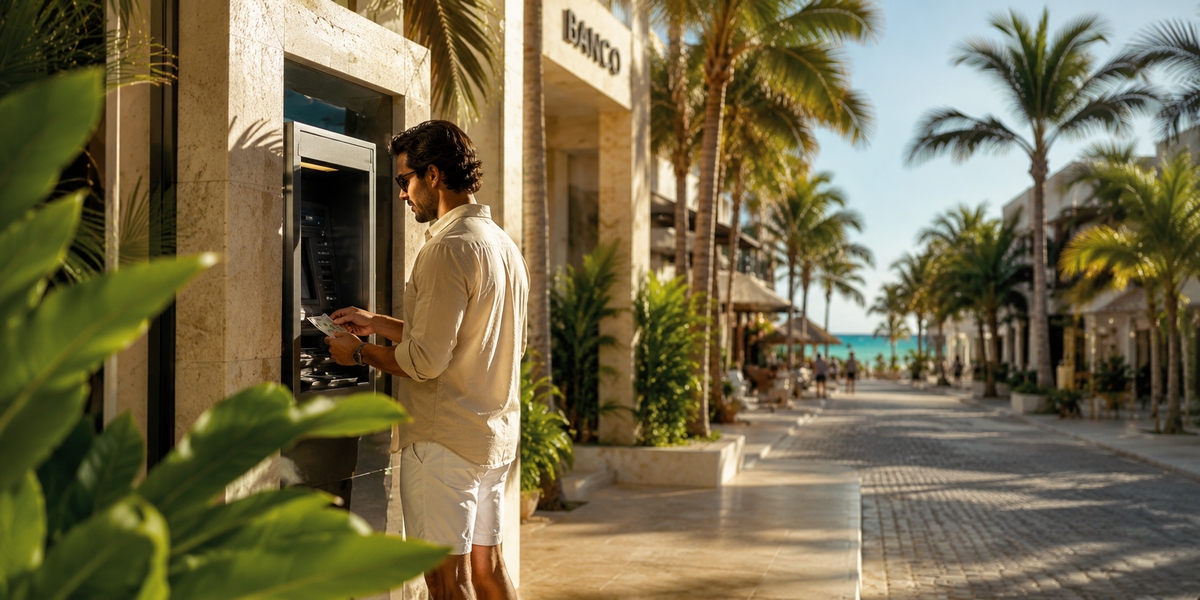
Notice that most of these aren't charged by Mexico at all — they're charged by your own card, your own bank, or a conversion service you said yes to. That's the good news hiding in the list: nearly every fee here is one you control with the card you pack and the buttons you press. The same compounding logic applies to the rest of a trip's budget, which the resort fees and hidden costs guide breaks down beyond just cards.
Always Pay in Pesos: The DCC Trap
If you remember one habit from this entire guide, make it this one. At a restaurant terminal, a shop, or an ATM, you'll be asked whether you want the transaction in Mexican pesos or in your home currency. The dollar option looks like a courtesy — you see a familiar number, no mental math. It is the most expensive button on the screen.
That offer is dynamic currency conversion, and the rate baked into it is set by the merchant's payment processor, not your bank. It typically runs 5% to 8% worse than the rate your own card would give you. Mexico's consumer protection agency, Profeco, has long warned travelers to pay in the local currency for exactly this reason.
Here's the part that trips people up, and it's worth saying plainly because the fear of it makes travelers accept DCC by accident: pressing the button that declines the dollar conversion does not cancel your transaction. The purchase still goes through — just in pesos, at the fairer rate. So when in doubt, always choose pesos. There is no scenario in Mexico where being billed in your home currency works out in your favor; the convenience you're being sold is the markup itself.
Smart Card Habits in Mexico
The right cards do most of the work, but a few habits squeeze out the rest of the savings and keep you out of trouble. None of them take effort once you've done them once.

That last habit pulls double duty. A backup card on a different network covers you not just for theft but for the everyday glitches — a fraud hold, a demagnetized stripe, a merchant whose machine won't read your card. A trip where one card failing is merely an inconvenience, not a crisis, is a trip you planned well. If you're building the full pre-departure picture, this slots in alongside the broader Cancun trip budget.
How Much Cash Should You Carry?
There's no universal number — carry only what the cash-only corners of your trip need and let cards do the rest. The right buffer shifts with the kind of trip:
- Cancun resort stay: card-heavy. A few thousand pesos covers tips, taxis, and beach vendors for several days.
- Riviera Maya trip: more cash-intensive — cenotes, colectivos, and small-town meals lean cash, so keep a fuller wallet.
- Digital-nomad stay: steadier; withdraw a week or two of spending at once to cut down ATM trips.
When unsure, carry less and refill at a bank ATM — topping up costs nothing extra, but flashing a thick stack does.
Card Mistakes Travelers Make
Almost every card regret in Mexico comes down to one of these four. They're easy to avoid once you've seen them named.
Pulling cash on a credit card. Using a credit card at an ATM is a cash advance: a fee plus interest from the moment you withdraw, no grace period. Use a debit card for pesos, always.
Accepting the dollar conversion. Saying yes to being billed in your home currency hands a 5–8% markup to the processor. Choose pesos and let your own bank convert.
Bringing only one card. One fraud hold or failed swipe and you're locked out of your own trip. A second card on a different network is cheap insurance.
Relying on American Express alone. Great at resorts and chains, often useless at small restaurants, local tours, and family shops. Keep a Visa or Mastercard as your base.
Sources Checked
Sources checked on June 21, 2026. Card terms, fee structures, and ATM charges change frequently and vary by bank and country, so confirm the foreign-transaction-fee line and ATM policy on your own card before you travel.
How this guide was checked: We compared official consumer-finance guidance on foreign transaction fees and dynamic currency conversion with current reporting on card features and Mexican ATM costs. The aim is to explain the features and habits that matter, not to recommend or rank any specific financial product.
Frequently Asked Questions
Do I need a special card to travel to Mexico?
No card is required to enter or pay in Mexico, but the card you bring decides how much you quietly lose. A regular bank card usually adds a foreign transaction fee of around 3% to every purchase and withdrawal. A card with no foreign transaction fee removes that, and a debit account that waives or reimburses ATM fees removes most of the cost of getting pesos. You do not need anything exotic; you need at least one no-foreign-fee card and, ideally, a fee-friendly way to pull cash.
What is a foreign transaction fee and how much is it?
A foreign transaction fee is a surcharge your card issuer adds to any purchase processed outside your home country. It is typically 1% to 3% of the amount, and 3% is the most common figure on basic US and Canadian cards. Roughly 1% goes to the card network for currency conversion and the rest to your bank. Most travel rewards cards and most cards with an annual fee waive it entirely, which is why bringing the right card matters more than any single tip in this guide.
Should I use a credit card or a debit card in Mexico?
Use both, for different jobs. A no-foreign-fee credit card is best for hotels, restaurants, tours, and anywhere you tap or insert a card, because it adds a layer of fraud protection and dispute rights and never touches your bank balance directly. A debit card is for cash: use it only at bank-branch ATMs to withdraw pesos, ideally one that reimburses ATM fees. Avoid using a credit card at an ATM, because that counts as a cash advance with extra fees and interest from day one.
Should I ever let an ATM or shop charge me in US or Canadian dollars?
No. When a machine or terminal offers to bill you in your home currency instead of pesos, that is dynamic currency conversion, and the exchange rate is usually 5% to 8% worse than your own bank's. Always choose to be charged in Mexican pesos and let your bank do the conversion. Pressing decline on the dollar offer does not cancel the transaction; it simply completes it in pesos at the fairer rate.
How many cards should I bring to Mexico?
Two as a minimum, on different networks. Carry a no-foreign-fee credit card for spending and a debit card for ATM cash, and try to have a backup on a separate network. Visa and Mastercard are accepted almost everywhere in Cancun and the Riviera Maya; American Express is hit or miss outside large resorts and chains. A second card on a different network protects you if one is blocked for a fraud flag, demagnetized, or simply not accepted.
Can I just use cash and skip cards in Mexico?
You will still want a card. Cards are the safest way to pay at hotels, larger restaurants, and for tours, and they give you a record and dispute rights if something goes wrong. But cash still matters for small vendors, taxis, tips, beach shacks, and colectivos. The realistic setup is a no-foreign-fee card for most spending plus enough pesos for the cash-only corners of the trip, which the money-in-Mexico guide covers in detail.
Before You Fly: Card Setup in One Minute
The short version, if you don't want to re-read the whole thing.
If you take one thing away: bring a no-foreign-fee credit card for spending and a fee-friendly debit card for cash, and pay in pesos every single time. That setup quietly removes the costs most travelers never notice they're paying.
For most US travelers, a no-foreign-fee travel card you already qualify for plus a fee-reimbursing checking account is the strongest, cheapest combination. Canadians have a shorter list of no-fee cards, so it's worth sorting that out before the trip rather than discovering the 2.5% on the statement.
Don't over-engineer it. You're not chasing the perfect rewards card — you're making sure no part of your week pays a fee it didn't have to. Two ordinary cards, chosen on purpose, do exactly that.