
The fear is almost always bigger than the trip. Parents picture the flight, a fever far from home, water they can't trust — and quietly wonder if they should just wait two years. Cancun and the Riviera Maya answer that worry better than most long-haul beach destinations: short flights from much of North America, calm Caribbean water in the right spots, and private hospitals that are used to foreign families.
But "it works" comes with conditions, and the conditions are specific. A baby trip lives or dies on small logistics that don't matter at all when your kids are older — whether the water is flat, whether a stroller can move, whether the formula water is safe, how far the nearest pediatric clinic is. Get those right and the week is genuinely easy. Get them wrong and you spend the trip improvising.
This guide is the under-three version of our broader Cancun family vacation guide — same destination, very different set of problems. It's about what to decide before you book, not a list of attractions a one-year-old won't remember.
Quick Answer: Can You Do It?
Yes — Cancun and the Riviera Maya are a sensible choice for a baby or toddler, and easier than most parents expect, if you pick a calm-water base and prepare for sun, water, and strollers. The destination itself is rarely the hard part; the small logistics are. Here's the whole thing in five lines.
- Base on calm, shallow water — north-facing Hotel Zone beaches or a reef-protected spot, not an open-surf strip.
- Request the crib at booking, not at check-in — and confirm it's a real crib, not a rollaway.
- Sort the car seat before you land — transfers don't include one unless you ask.
- Use sealed or boiled water for formula and for cleaning bottles — never the tap.
- Plan around shade and the midday heat, especially for babies under six months.
Best Areas at a Glance
If you only need the where, start here. Four bases cover almost every baby trip on this coast, and they aren't equal for a child under three. In short: North Hotel Zone for the easiest trip, Playa del Carmen for walkability, Puerto Morelos for quiet, and Tulum is the hardest with a baby. The full comparison — calm water, strollers, medical access — is in the section below.
Calm north-facing water, the shortest airport transfer, and the closest hospitals. The path of least resistance for a first baby trip.
A small, reef-protected village with flat water and a slow pace. Manageable with a stroller in its compact center.
Real sidewalks, pharmacies, and clinics within a stroller's reach. The best base if you want to leave the resort daily.
Lovely for adults, awkward for infants: open surf, soft sand that defeats a stroller, and a long, taxi-dependent beach road.
Match Your Child's Stage to the Trip
"Baby or toddler" covers three very different travelers. The age your child will be on the trip — not today — decides what the week actually looks like and the one thing worth prioritizing. Find your row before you read anything else.
The easiest age to travel in some ways — they don't move — but the most sun- and heat-sensitive. They should stay out of direct sun entirely. Prioritize: deep shade, a cool room, and feeding on demand. Pool time is brief and gentle.
Now they want the floor, the sand, and everything within reach in their mouth. Hygiene and a safe, contained space matter most. Prioritize: a shallow kiddie pool, a clean room they can be put down in, and a calm shoreline with no drop-off.
Mobile, fast, and fearless near water — the highest-supervision stage. Naps and meal timing rule the day. Prioritize: a flat, walkable base, water you can stand in with them, and a layout where the room, pool, and food are close together.
One honest note across all three: the photogenic part of the trip is short. Very young children run on naps and routine, and the realistic win is a calm few hours by the water each day, not a packed itinerary. Parents who accept that early have a far better time than parents who fight it.
Is Cancun Actually Right for a Baby Trip?
For most families, yes — and the reasons are practical, not scenic. Flights are short enough that a nap or two covers the journey. The big all-inclusive resorts remove the daily friction of finding safe food and clean facilities. And the water, in the right place, is bath-warm and flat. That combination is hard to beat for a first trip with a small child.
Here's the part people get backwards. The risk parents fear most — a medical emergency abroad — is real but well-covered by private hospitals here. The thing that actually derails baby trips is mundane: a room a ten-minute walk from the pool, a beach with surf and undertow, soft sand that swallows a stroller, and a sun that's punishing by 11am. None of that shows up in a booking photo, and all of it is avoidable with the right base.
Where Cancun is the wrong call: if your dream is a touring trip — ruins, cenotes, long drives, a different town every two days — a baby will quietly veto it, and you'll resent the schedule. That itinerary is better two or three years later. With a child under three, the resort or the calm beach is the trip, and the families who book it that way rarely regret it.
Where to Base: Calm Water Comes First
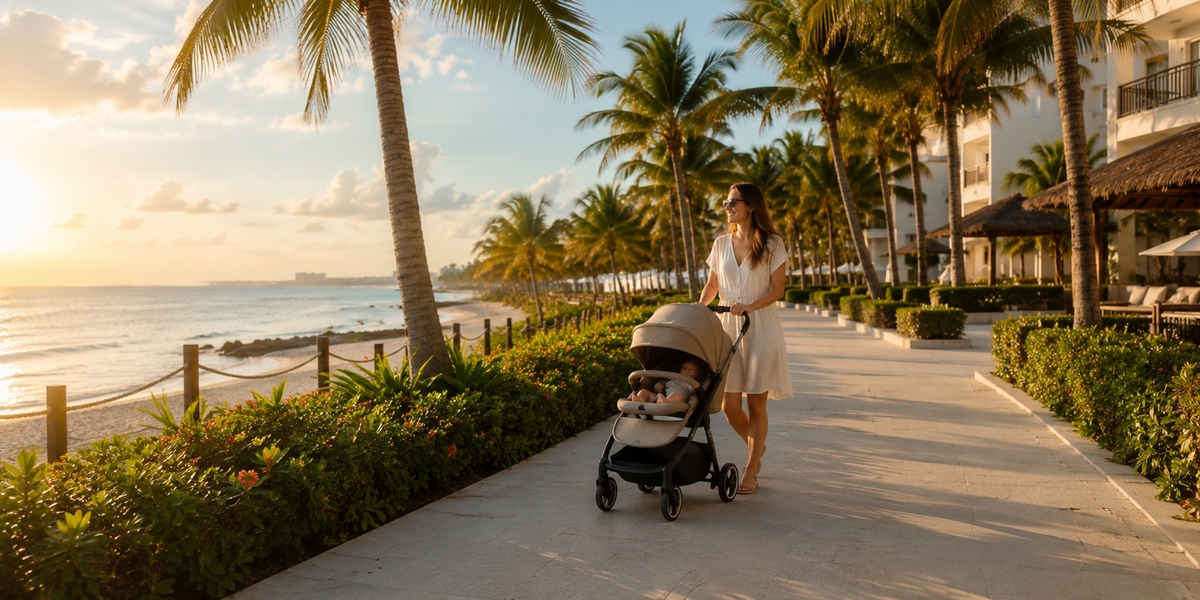
This is the single most consequential decision, and it's where the marketing photos mislead. The long, dramatic Hotel Zone beach you picture — the one facing the open Caribbean — is the wave-and-undertow side. The flat, baby-friendly water sits on the shorter north-facing stretch of the Hotel Zone (around Playa Tortugas and Playa Caracol) and in reef-protected spots like Puerto Morelos. Same region, completely different swim.
Here's how the main bases compare on the things that matter with a very young child — not on nightlife or restaurants.
| Base | Calm, shallow water | Stroller-friendly | Pediatric care nearby | Transfer from CUN |
|---|---|---|---|---|
| North Hotel Zone (Cancun) | Often calm | Resort paths only | Closest | ~20–30 min |
| Puerto Morelos | Reef-protected | Small, walkable core | Cancun ~30 min | ~30–40 min |
| Playa del Carmen | Mixed by beach | Walkable town | Town clinics | ~50–60 min |
| Tulum | Open surf | Soft sand, spread out | Limited, drive needed | ~90 min |
The pattern is blunt: the closer you stay to Cancun, the easier a baby trip gets, and Tulum — for all its appeal to adults — is the hardest place to do this. Soft sand, a long taxi-dependent beach road, and thinner medical access add up fast when you're carrying a one-year-old. If you want the walkable middle ground with real sidewalks and shops, Playa del Carmen is the compromise; if you want zero logistics, the north Hotel Zone wins. For the resort itself, our pick of family resorts in Cancun goes deeper on specific properties.
What to Check Before You Book the Hotel
A resort can be excellent for adults and quietly hostile to a baby. Four things decide it, and none of them appear on the headline rate. Confirm each in writing before you pay — "we'll see at check-in" is how families end up with a rollaway bed and a pool that's too cold.
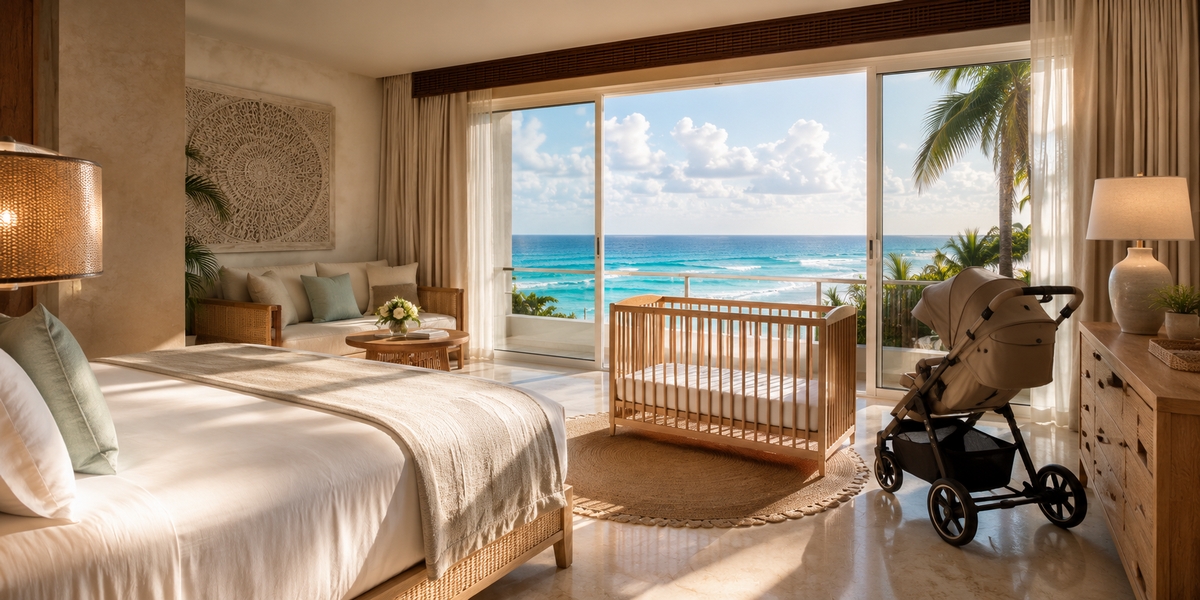
Crib and sleep
- Request the crib at booking — supply is limited and runs out;
- confirm it's an actual crib, not a rollaway or a pull-out;
- ask about a quiet room away from the lobby, bar, and nightly entertainment.
Pool and water temperature
Look for a genuinely shallow kiddie pool with shade over it. Big resort pools can feel cold to a baby in the morning, and few are heated — early swims are often a non-starter, so plan pool time for the warm afternoon.
Food and formula
All-inclusive buffets help, but check for baby-appropriate food and ask how allergies are handled. Bring your own formula from home, and remember the room's safe-water situation matters more than the menu.
Room logistics
- Ask for a ground-floor or low room close to the pool and food;
- check the real walking distance from room to beach;
- request a kettle to boil water if you'll mix formula.
Beach, Sun and Heat
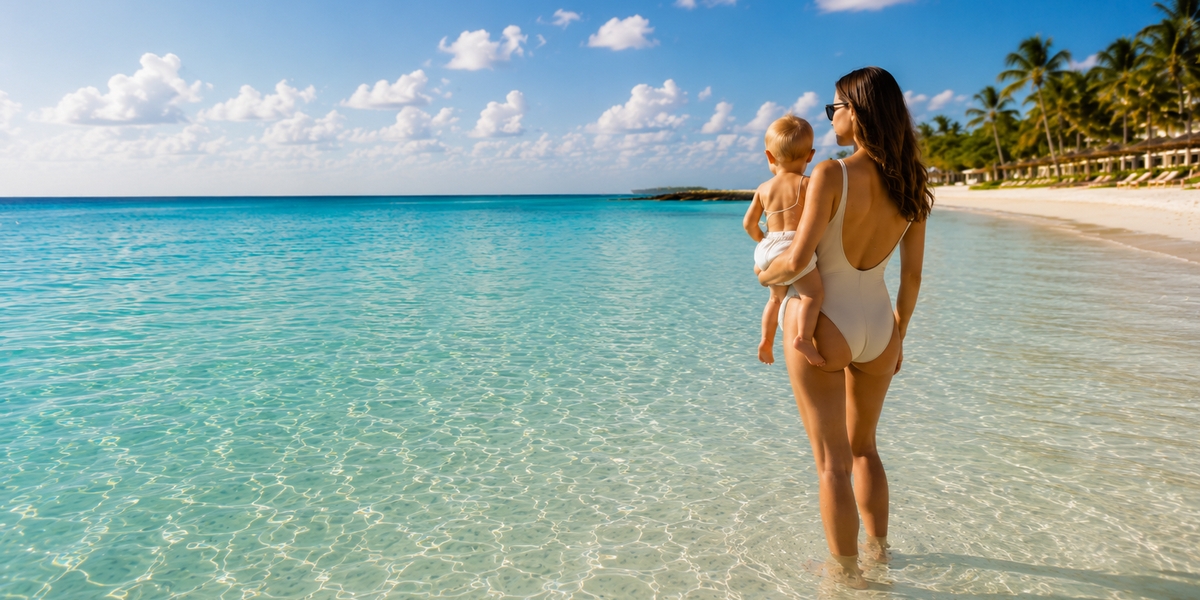
The sun is the part most parents underestimate. Caribbean UV is strong, and a baby overheats and burns far faster than an adult. The American Academy of Pediatrics, through its HealthyChildren guidance, is direct about it: keep babies under six months out of direct sunlight entirely, lean on shade, light long-sleeved clothing, and a wide-brimmed hat, and treat roughly 10am to 4pm as time to be out of the sun, not in it.
That reshapes the day in a useful way. Mornings before the heat and late afternoons are baby time; the harsh middle of the day is for the room, a nap, and the shade. Sunscreen is a last resort under six months — only small areas like the face when shade and clothing aren't enough — so a shaded stretch of beach or a pool cabana matters more than any product you pack. Overheating is the quieter danger: babies can't regulate temperature well, so keep them cool and feed often, because hydration is the defense.
And the sand surprise no one mentions: a beach is not a stroller surface. Wheels sink, and you end up carrying the baby anyway. A carrier or sling does more work on this trip than the stroller will.
Food, Water and Health
Water is the rule that protects the whole trip. The U.S. CDC Travelers' Health guidance treats Mexican tap water as unsafe for travelers, and for infants it's stricter: prepare formula only with water that's been boiled and cooled, or commercially bottled from a sealed, reputable container — and use that same safe water to clean bottles, pacifiers, and teething toys. Skip ice you can't vouch for. If you're breastfeeding, that's the simplest, safest option on the road; if you're not, bring your usual formula from home rather than buying an unfamiliar local product.
On medical care, the reassurance is genuine. Private hospitals — Galenia and Hospiten in Cancun, AmeriMed along the coast — handle pediatric and emergency cases, often with English-speaking staff and experience with foreign families. The catch is financial, not clinical: care is typically pay-up-front and claim back, so travel insurance that explicitly covers your child's age is essential, and it's worth confirming which hospital your insurer treats as a preferred provider before you fly. Save the nearest hospital's location offline on day one.
Transfers, Car Seats and Strollers
Two pieces of gear decide how smooth the ground game is, and the first is a genuine safety point people skip. Mexican law requires child restraints, but commercial transfer vehicles are frequently exempt and enforcement is patchy, so a private transfer will not have a car seat in the vehicle unless you arrange it in advance — sometimes for a small add-on fee. The ride where this matters most is the high-speed highway from Cancun airport down to the Riviera Maya, which can run 90 minutes to Tulum. Request the seat when you book, or bring your own for guaranteed fit and cleanliness; our transfer options guide covers the trade-offs between private, bus, and rental.
The stroller is the other one, and the honest answer is that it's a sidewalk-and-resort tool, not a beach tool. A light, foldable stroller earns its place on paved resort paths, in Playa del Carmen's walkable streets, and at the airport. On sand it's dead weight. Most families pair a compact stroller with a carrier and let the carrier do the beach and travel-day work.
- Request the crib and the car seat in advance — both run out or simply won't appear otherwise.
- Pack more sun protection and rehydration supplies than you think you need; both are harder to buy on the spot.
- Bring formula from home; don't plan to source it locally.
- Keep one calm-water day as the default and treat any outing as a bonus, not the plan.
Mistakes to Avoid
Almost every baby-trip regret here traces back to one of these four. They're easy to dodge once someone names them.
Booking a surf-facing beach. The dramatic open-Caribbean stretch has waves and undertow. With a baby you want the flat, north-facing or reef-protected water — check the beach orientation, not just the resort.
Skipping the car seat on the highway. The airport-to-resort run is fast and long. "The transfer didn't have one" is not a safety plan — arrange a seat or bring your own.
Using tap water or unverified ice for formula. The most common avoidable illness at this age. Sealed-bottled or boiled water only, for mixing and for cleaning bottles.
Planning a touring itinerary. Ruins, cenotes, and long drives don't mix with naps and a stroller. Over-scheduling a child under three turns the trip into damage control.
There's a fifth that isn't really a mistake — it's a decision worth making honestly before you book.
- You're traveling with a newborn under a few months and the anxiety outweighs the appeal.
- Your child has a medical need that's harder to manage far from your own pediatrician.
- Tulum is your heart's pick and a stroller-free, surf-side week sounds exhausting rather than romantic.
- You actually want a touring trip — in which case wait two or three years and do it properly.
Sources Checked
Sources checked on June 22, 2026. Health guidance, hospital details, and transfer policies change, and individual hotels vary widely, so confirm crib, car-seat, and medical-provider details directly before you travel.
How this guide was checked: We drew on official pediatric and travel-health guidance for infants — the U.S. CDC on food, water, and traveling with children, and the American Academy of Pediatrics on infant sun and heat safety — alongside current information on private hospital care and child-restraint practice in the Cancun and Riviera Maya area. The aim is to help families decide and prepare, not to replace medical advice.
Frequently Asked Questions
Is Cancun safe for a baby or toddler?
Yes, with ordinary precautions it is a common and workable destination for very young children. The real risks are not dramatic: sun and heat, dehydration, and an upset stomach from the wrong water are the everyday concerns, and all three are manageable. Stay out of the midday sun, keep the baby hydrated and shaded, use sealed or boiled water for formula, and base yourself somewhere with calm, shallow water. Private hospitals in Cancun and along the Riviera Maya have pediatric care, so confirm which one your travel insurance lists before you go.
Can I use tap water for baby formula in Cancun?
No. The U.S. CDC advises against tap water for travelers in Mexico, and for infant formula it goes further: use a disinfected source, meaning water that has been boiled and cooled or commercially bottled from a sealed, reputable container. Use that same safe water to clean bottles, pacifiers, and teething toys. If you are breastfeeding, that is the simplest and safest option of all on the road, and bringing your usual formula from home avoids any local-product surprises.
Do I need a car seat for the airport transfer?
You should use one, and you have to arrange it yourself. Mexican law requires child restraints, but commercial transfer vehicles are often exempt and enforcement is inconsistent, so private transfers do not put a car seat in the vehicle unless you request it in advance, sometimes for a small fee. The ride that matters most is the highway between Cancun airport and the Riviera Maya, where speeds are high. Request a seat when booking, or bring your own for guaranteed fit and cleanliness.
Which area is best with a baby — Cancun, Playa del Carmen, or Tulum?
For a baby or toddler, prioritize calm water and short logistics, which points to the north-facing Hotel Zone beaches in Cancun or a reef-protected spot like Puerto Morelos. Playa del Carmen is a strong middle choice because it is walkable with a stroller and close to pharmacies and medical care. Tulum is the hardest with a very young child: the beach strip has open surf, the road is long and taxi-dependent, and soft sand makes a stroller nearly useless.
Can I bring a stroller to the beach?
A standard stroller does not roll on soft sand, so it stalls the moment you leave the pool deck. Most parents end up carrying the baby across the sand and using a carrier or sling for the beach and for travel days, then keeping a light, foldable stroller for the resort paths, sidewalks, and the airport. If walkable streets matter to you, Playa del Carmen handles a stroller far better than Tulum or a spread-out resort.
Is there good medical care for young children near Cancun?
Yes. Private hospitals such as Galenia and Hospiten in Cancun and AmeriMed along the coast handle pediatric and emergency cases and are used to international patients, often with multilingual staff. Care is generally pay-up-front and then claimed back through insurance, so carry a travel policy that explicitly covers your child's age, keep the hotel-zone hospital locations handy, and confirm in advance which facility your insurer treats as a preferred provider.
Can babies swim at Cancun's beaches?
For a baby it's more dipping than swimming, and the spot decides everything. Stick to the calm, shallow, north-facing Hotel Zone beaches or reef-protected water like Puerto Morelos, where there's no surf or undertow; the open-Caribbean stretches have waves that aren't suitable for a small child. The water is warm year-round, so brief, shaded paddles work well. For the youngest babies, a shallow resort kiddie pool is often easier and safer than the sea.
Are mosquitoes a problem for babies in Cancun?
They can be, mostly in the rainy months and away from the breezy beachfront — inland, around jungle and cenotes, and in places like Tulum. Mexico has mosquito-borne illnesses, so physical protection comes first for infants: a mosquito net over the stroller or crib, light long sleeves at dusk, and a room with screens or air conditioning. Repellents have age limits — the AAP advises against DEET under two months and oil of lemon eucalyptus under three years — so check with your pediatrician before using any.
What's the best month to visit Cancun with a toddler?
The drier, less punishing months — roughly December through April — are easiest with a small child: lower humidity, gentler heat, and calmer conditions. Late summer and early fall bring peak heat, the most rain, and the height of hurricane season, while seaweed (sargassum) tends to be heaviest from spring into summer. None of it rules out a trip, but a winter or early-spring week is the most comfortable for a baby.
Can I buy diapers and baby supplies in Cancun?
Yes. Supermarkets like Walmart, Chedraui, and Soriana, plus pharmacies, stock diapers, wipes, and baby food in Cancun and Playa del Carmen, though brands may differ from home. Formula is sold locally too, but it's safest to bring your usual formula rather than switch mid-trip. If you're deep inside a resort or out in Tulum, supplies are less convenient, so pack enough for the first day or two.
Do resorts provide cribs for free?
Often, but never assume it. Many hotels and all-inclusives offer a crib at no charge, but supply is limited, some properties charge a small fee, and a few only have rollaway beds. Request the crib when you book rather than at check-in, and confirm in writing that it's an actual crib — this is one of the most common day-one surprises for families with a baby.
Before You Fly: The Baby-Trip Shortlist
The decisions that make or break the week, in one pass.
If you take one thing away: choose the location for the baby first — calm shallow water, a stroller-friendly base, and a pediatric hospital within reach — and let the rest follow. Cancun handles a very young child well when geography is on your side.
For most families, the north Hotel Zone or Puerto Morelos is the easiest first trip; Playa del Carmen is the walkable middle ground. Save Tulum and any touring itinerary for when the child is older — with a baby, the calm beach itself is the vacation, and that's the trip people are glad they took.
Prepare the water, the shade, and the car seat, accept the slower pace, and the week is far easier than the worry that came before it.