
Akumal means "place of the turtles" in Maya, and for once the marketing and the biology agree. In this shallow, curved bay between Playa del Carmen and Tulum, wild green sea turtles graze on a seagrass meadow that starts only a few meters past the waterline. You do not need a boat, a reef crossing, or luck on a migration window. On a good morning you wade out, put your face in the water, and a turtle the size of a coffee table is calmly eating below you.
That accessibility is exactly why it goes wrong so often. Akumal is one of the most searched activities on the Riviera Maya, which means it is also one of the most crowded, most regulated, and most oversold. The version in the drone footage — empty water, a single snorkeler, a turtle gliding past — is real, but it exists for about two hours a day and not at all on the wrong dates.
This guide is the honest brief most operators skip: where the turtles actually are, the difference between swimming the bay yourself and paying for the guided circuit, the one timing decision that quietly determines your whole experience, what it costs, the rules that keep it sustainable, and why the "quiet alternative" you may have read about does not have turtles at all.
Quick Answer: How to Do Akumal Right
The short version: come early, decide between a self-guided shallow swim and a guided seagrass circuit, and treat the morning as non-negotiable. Akumal rewards the snorkeler who is in the water by nine and punishes the one who shows up at noon expecting the photos.
- Where: Akumal Bay, on the seagrass — not Yal-Ku Lagoon, which has fish, not turtles.
- Guide: mandatory in the deeper turtle zone (up to ~6 people, ~55 min); optional in the shallow swim zone near shore.
- Cost: beach entry ~120 MXN (~$6–7); guided circuit ~500–800 MXN (~$25–40), gear and life jacket usually included.
- Best time: at opening, around 9 a.m.; turtles feed year-round, with May–November the most active and October–November the calmest.
- The catch: fine sand clouds the bay by late morning, so a midday visit can mean murky water and a wall of people.
Pay the beach entry, rent a mask, and snorkel the near-shore zone yourself. Turtles wander in, especially first thing.
A licensed guide takes a small group to the deeper feeding meadow where turtle density is highest. Gear and vest included.
Gentle, sheltered water for beginners and young children. Yal-Ku is a separate paid lagoon, great for fish.
If a midday arrival is your only option, the bay will disappoint. A reef tour or a cenote reads better at that hour.
Why the Turtles Are Here at All
Most "swim with turtles" experiences are really "boat out and hope." Akumal is different because of geography, and the geography is worth understanding before you go, because it explains every rule and every frustration.
The bay is a shallow, gently curved scoop of water protected by a reef line offshore. That reef knocks down the waves, so the water inside stays calm enough for a beginner to float in. On the sandy bottom grows a meadow of seagrass, and green sea turtles are grazers — this is, simply, their dining room. They come to eat, they stay because the food is reliable, and they tolerate snorkelers because thousands pass through every week. None of this is staged or fed; it is a genuine wild feeding ground that happens to sit a short swim from a public beach.
The same shape that makes it special makes it fragile. A calm, shallow bay with a fine sandy floor clouds up the moment too many fins stir it, which is why mid-morning visibility collapses. The seagrass that feeds the turtles is slow-growing and easily damaged, which is why fins are discouraged and the deep meadow is roped off and guided. Understanding that the bay is a working ecosystem, not a water park, is the difference between a traveler who gets it right and one who leaves a one-star review about crowds they helped create.
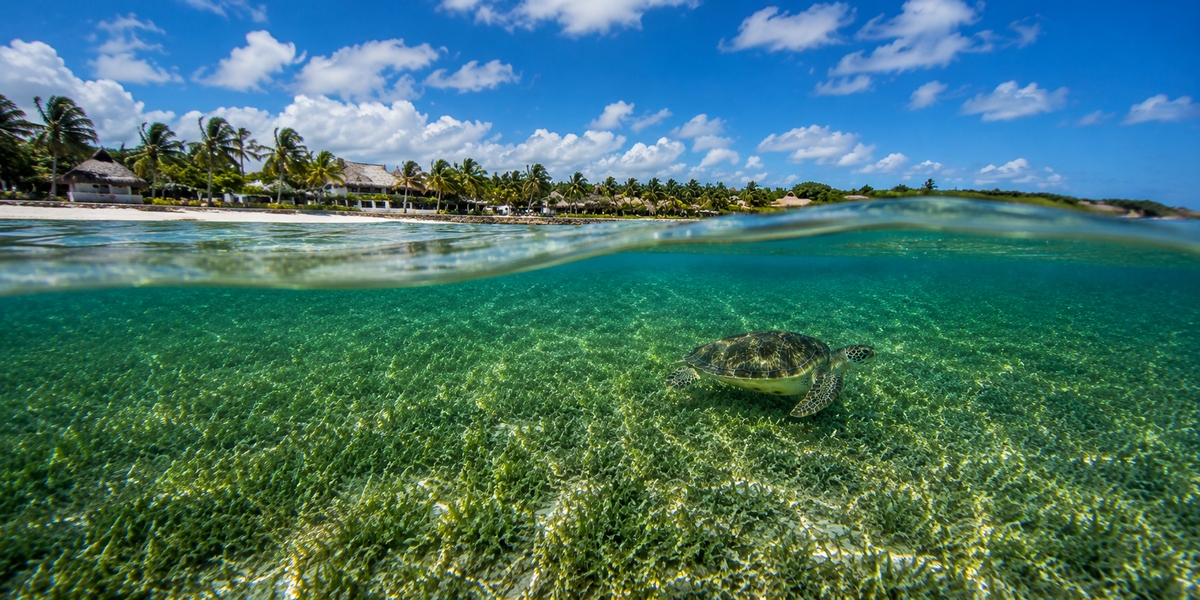
It also helps to know what you will and will not see. Green turtles are the headline act, often several in a single session once you are over the seagrass. You may share the water with rays, the odd barracuda, and schools of fish. What you will not get is the technicolor coral wall of a dedicated reef trip — Akumal is a seagrass bay, not a reef dive. If vivid coral is what you are picturing, that is a different outing entirely, and the best snorkeling spots around Cancun and Cozumel are the better match.
Free Beach vs Guided Circuit: The Real Choice
Almost all the confusion about Akumal comes down to one thing nobody explains clearly: there are two different ways into the water, with two different price tags and two different experiences, and touts at the entrance have every reason to blur them.
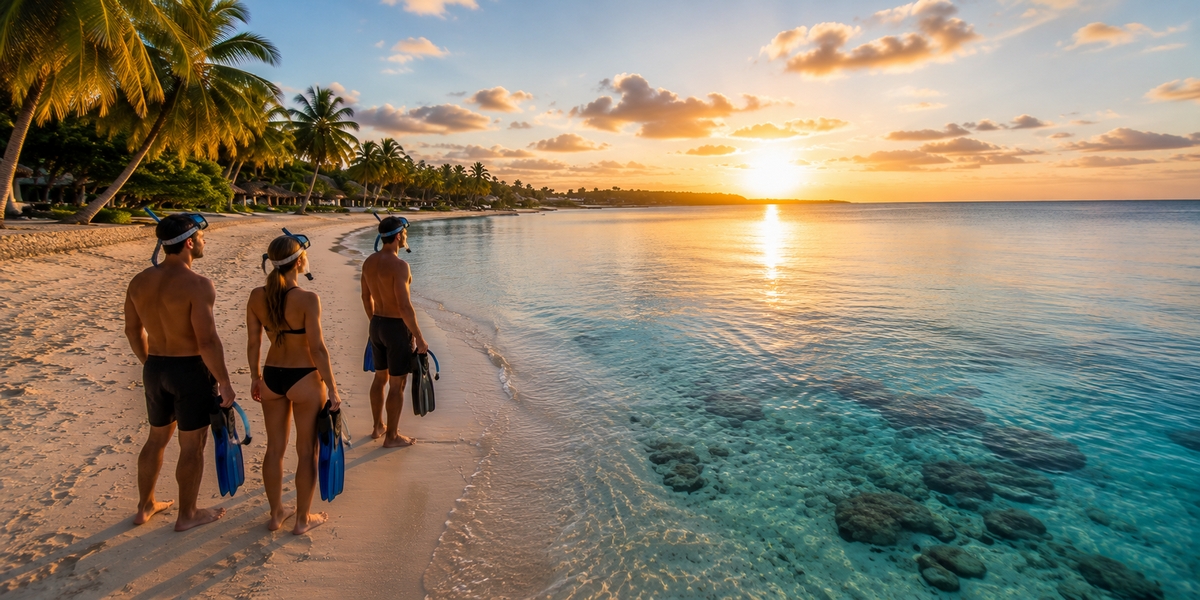
Under Mexican law, the beach itself is public, so in principle the sand and the shallow water are free. In practice, the access points are run by businesses and a managed entrance that charge a facility fee — usually around 120 MXN, or about five US dollars if you go through the Centro Ecológico Akumal building, which buys you restrooms and lockers. That gets you into the shallow swimming zone near shore, where you can snorkel on your own, and where turtles genuinely do appear, especially in the first hour of the day.
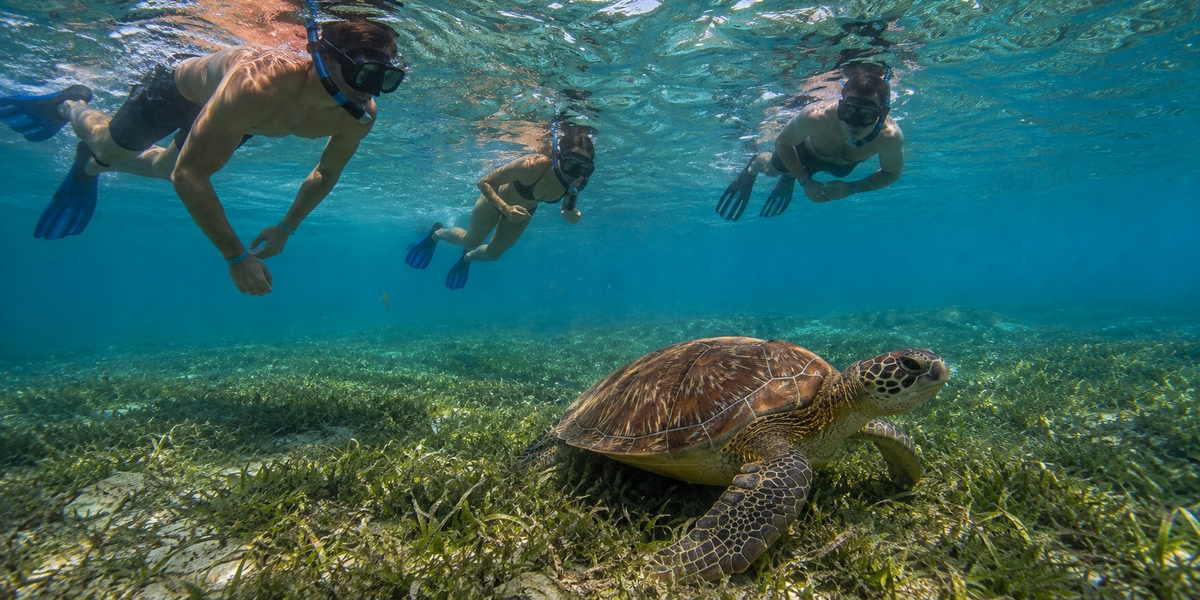
The deeper seagrass meadow, where turtle density is highest, is a regulated zone. There, an authorized guide is mandatory: small groups of up to about six people, sessions of roughly 55 minutes, booked at the official kiosk by the entrance, for something like 500 to 800 MXN per person. That fee normally bundles the guide, the mask and snorkel, and the life jacket you are required to wear in the circuit. The rules are not an upsell invented by operators — they are conservation measures set by Mexico's federal protected-areas authority, CONANP, to cap how many people are on the seagrass at once.
Here is the decision in money terms. A couple who wants the strongest turtle odds and the reassurance of a guide budgets roughly 1,200 MXN for two circuit spots — about $65 to $70 — plus the small entry or locker fee. The same couple who is comfortable snorkeling and arrives at opening can instead pay only the entry fee and around 200 to 300 MXN to rent two masks, then float the shallow zone and wait for turtles to drift through. Neither is wrong. The guided circuit buys density and supervision; the self-guided swim buys savings and freedom, at the cost of fewer turtles and managing yourself. Strong swimmers on a budget lean self-guided; nervous or first-time snorkelers, and anyone with a wobbly relationship to open water, get more out of the guide.
Which Akumal Fits You
There is no single right way to do Akumal — there is the right way for the trip you are actually taking. Match your situation to one of these before you stand at the entrance deciding under pressure with a tout talking at you.
Self-guided early swim
→ Pay the entry, rent a mask, and be floating the shallow zone at opening. Cheapest route, and at 9 a.m. the turtles come to you before the crowds and the cloud roll in.
Guided seagrass circuit
→ Book the kiosk guide for the deep meadow. Highest turtle density, a small group, and a pro watching the water — worth the fee if seeing turtles is the whole point.
Shallow bay, gentle pace
→ Stay in the sheltered near-shore water, keep expectations soft, and let a sighting be a bonus. For pure calm-water snorkeling with fish, Yal-Ku Lagoon suits small children better.
Skip it, snorkel elsewhere
→ If you cannot arrive early, Akumal will hand you murky water and a queue. A cenote or a reef tour is the better midday call.
Timing Is Everything (and It Is Not Close)
If you take one thing from this guide, take this section. At Akumal the clock matters more than the choice of guide, the season, or the gear. Two things degrade together as the morning wears on: the crowd builds, and the fine sandy bottom gets stirred into a haze that swallows visibility. The bay that was glass at nine can be milk by eleven, and a turtle two meters away simply vanishes into it.
The villain is the tour bus. Organized groups from Cancun and Playa del Carmen reach Akumal mid-morning, often with first-time snorkelers who kick the bottom, and the water clouds fast once they are in. Your whole strategy is to be finished, or nearly, before they arrive. That means treating the morning as a short, fixed timeline rather than a loose plan.
Leave Tulum or Playa early enough to beat the tour buses. A line forms at the entrance before it even opens.
Pay the entry, sort gear or meet your guide. The first water of the day is calm, clean, and uncrowded.
Peak visibility and feeding. Whether you are self-guided in the shallows or on the circuit, this is the hour that makes the trip.
Buses arrive, the sand lifts, visibility drops. If you started at nine, you are already drying off and watching the queue grow.
Season is the softer lever. Green turtles graze the bay all year, so sightings are reliable in any month, but the experience around them changes. The nesting months of roughly May through November are the most active, while the comfort sweet spot is October and November, when summer sargassum has mostly cleared, the heat has eased, and the winter crowds have not yet landed. The dates to approach with caution are the mid-December to March high season and Semana Santa — March 29 to April 5 in 2026 — when day-trippers swamp the bay and even a 9 a.m. start feels busy. On any date, a weekday beats a weekend.
The Yal-Ku Lagoon Myth
Here is the correction that competitors selling tours rarely make. Search around Akumal and you will keep meeting Yal-Ku Lagoon, often framed as the quieter, secret place to swim with turtles. It is quieter. It is genuinely lovely. It is not a turtle spot.
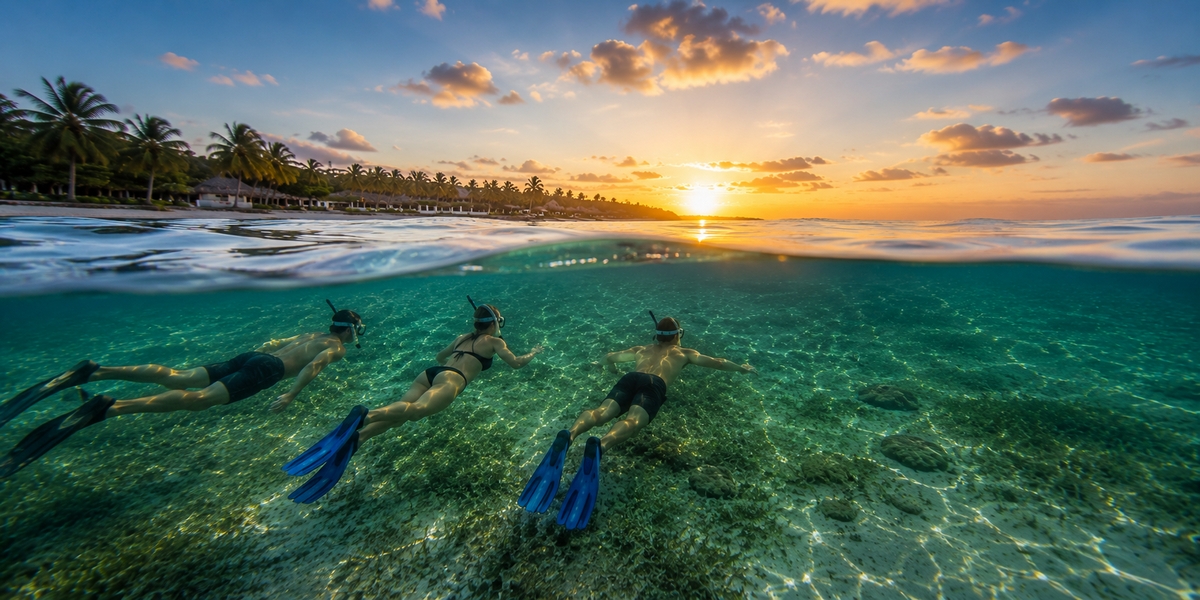
Yal-Ku sits just north of Akumal Bay, where fresh groundwater meets the Caribbean. The mix draws a surprising amount of fish, the water is calm and shallow, and it is one of the better introductions to snorkeling for nervous adults and young kids — closer to a giant natural aquarium than open sea. But the turtles feed on the seagrass in the bay, not in the lagoon. People do occasionally report one, the way you occasionally see anything, but planning a turtle swim at Yal-Ku is planning to be disappointed.
Worth knowing before you go: unlike the technically-public beach, Yal-Ku is a paid attraction in its own right, usually somewhere around 18 to 20 US dollars per adult, open about 9 a.m. to 5 p.m., with the same early-is-better rule for visibility. Think of it as a complement, not a substitute — a gentle fish snorkel you might pair with a turtle morning in the bay, not a clever workaround to find turtles without the crowds. If a calmer, fish-first swim actually sounds better than chasing turtles in a busy bay, that is a perfectly good plan; just go in knowing what each place is.
Mistakes That Ruin an Akumal Morning
Most Akumal disappointment is not bad luck. It is one of a handful of avoidable mistakes, and every one of them is easy to sidestep once you know it is coming.
Arriving mid-morning or later. This is the big one. You inherit the worst visibility and the biggest crowds of the day in a single decision. Nine a.m. and noon are two completely different bays.
Touching or chasing a turtle. Beyond being illegal in a protected area and carrying steep fines, it stresses the animal and gets your whole group flagged. Keep distance; let the turtle ignore you.
Wearing regular sunscreen. Non-reef-safe sunscreen is prohibited because it harms the seagrass and the marine life. Apply reef-safe well before the water, or wear a rash guard and skip it.
Paying the roadside "ticket" sellers. The only real fees are at the actual beach entrance. Vendors flagging mandatory tickets or rentals near the highway are the classic Akumal hustle.
Day Trip or Overnight?
For most travelers, Akumal is a half-day, not a base. It sits almost exactly between Playa del Carmen and Tulum, which makes it an easy early start from either: you are at the bay for opening, in the water for the good hour, and back for lunch with the rest of the day intact. That rhythm pairs naturally with the cenotes inland or a ruins stop, and it slots cleanly into a wider Riviera Maya day-trip plan rather than eating a whole vacation day.
Staying overnight in Akumal is a narrower call. The village is small and quiet, with a handful of condos and boutique stays rather than a resort strip, and the payoff is precisely that you can walk to the entrance at opening and beat every bus before it leaves Cancun. If a guaranteed, crowd-free first swim matters more than nightlife and dining choice, one night earns its place. If you want restaurants, bars, and options after dark, base in Playa del Carmen or Tulum and treat Akumal as the early-morning errand it does best.
Sources Checked
Sources checked on June 17, 2026. Fees, opening hours, guide requirements, and seasonal conditions at Akumal shift with the operator, the season, and local regulation, so confirm the current rates and rules at the official entrance kiosk when you arrive and bring cash in pesos.
How this guide was checked: We compared official and conservation sources on the bay's protected status and guide rules, the Centro Ecológico Akumal's visitor guidance, and recent traveler-facing reports on costs, crowds, timing, and the roadside-ticket scam. The goal is to set realistic expectations and protect both your morning and the turtles, not to predict one exact price on one exact day.
Frequently Asked Questions
Do you need a guide to swim with turtles in Akumal?
It depends on where you swim. The shallow swimming zone close to shore is open to self-guided snorkelers who pay the beach entry, and turtles do drift into it, especially early. The deeper seagrass meadow where turtle density is highest sits inside a regulated zone, and there an authorized guide is mandatory under the marine-park rules enforced by CONANP, with small groups of up to about six people and roughly 55-minute sessions booked at the official kiosk by the beach entrance. So you can go without a guide, but the best turtle odds are inside the guided circuit.
How much does it cost to swim with turtles in Akumal?
Budget two layers. A beach entry or facility fee runs around 120 MXN, roughly 6 to 7 US dollars, and entering through the Centro Ecologico Akumal building is about 5 US dollars with washrooms and lockers. On top of that, a guided turtle circuit is usually 500 to 800 MXN per person, about 25 to 40 US dollars, and that price normally includes the guide, the mask and snorkel, and the life jacket. If you snorkel the shallow zone yourself, you skip the guide fee and only rent gear, around 150 to 300 MXN for a mask and snorkel. Bring cash in pesos, since the kiosks are not card-friendly.
What time should you arrive at Akumal to see turtles?
As early as you can, ideally at opening around 9 a.m. and parked well before that. Two things degrade through the morning at once: the crowds and the water clarity. Akumal Bay has a very fine sandy bottom that clouds up as more snorkelers, especially inexperienced ones on mid-morning tours, stir it. By late morning the same water that was glassy at nine can be milky, and the turtles are harder to spot in it. Arriving early is the single biggest lever you have over the quality of the experience.
Is Akumal Beach free to enter?
The beach itself is public under Mexican law, so the sand is free. In practice, most access points run through businesses or a managed entrance that charges a small facility fee for lockers, restrooms, or shaded areas. The honest summary is that the beach is free but reaching it usually is not. Be aware of vendors near the highway who claim to sell required entry tickets, which are a known scam flagged in traveler reports and consumer warnings; the only real fees are paid at the actual beach entrance, not at a roadside table.
Can you see sea turtles at Yal-Ku Lagoon?
Rarely, and you should not plan on it. Yal-Ku Lagoon, just north of Akumal Bay, is a calm, paid snorkeling spot where fresh water meets the sea, and it is excellent for colorful fish, beginners, and young children. But it is not a turtle habitat. The turtles feed on the seagrass in Akumal Bay, not in the lagoon. If swimming with turtles is the goal, go to the bay; treat Yal-Ku as a separate, gentler snorkel rather than a quieter way to find turtles.
What is the best time of year to swim with turtles in Akumal?
Green turtles feed in the bay year-round, so there is no truly bad season for sightings, but the nesting months of roughly May through November are the most active. The most comfortable window is October and November, when the sargassum seaweed has mostly cleared, crowds thin out after the summer, and the busy winter has not started. Avoid the packed stretches if you can: the mid-December to March high season and Semana Santa, which falls March 29 to April 5 in 2026, bring the heaviest crowds and the worst midday visibility.
Is swimming with turtles in Akumal ethical for the animals?
It can be, if you follow the rules that exist precisely to protect the turtles and their seagrass. The bay is a regulated conservation area: stay within the marked buoys, keep your distance, never touch, chase, or block a turtle, skip fins so you do not kick up or tear the seagrass, and use only reef-safe sunscreen, applied well before you enter, or none at all. Touching or harassing a turtle carries heavy fines. The Centro Ecologico Akumal and the federal protected-areas authority manage the bay for exactly this reason, and a well-behaved snorkeler does no harm.
Akumal in One Minute
The short version, if you skipped to the bottom.
Akumal is worth it, on one condition: treat it as an early morning and nothing else. Get to the bay for opening and you get the experience the photos promise; arrive at midday and you get murky water and a crowd.
For most people the smart play is a self-guided shallow swim at 9 a.m., cheap and uncrowded, with turtles drifting through before the buses land. If seeing turtles up close is the entire reason for the trip, or open water makes you uneasy, pay for the guided seagrass circuit and let the density and supervision do the work.
And drop the Yal-Ku shortcut. The lagoon is a fine, gentle snorkel, but the turtles are in the bay — go where they actually eat, go early, and follow the rules that keep them there.